Commercially available matrices:
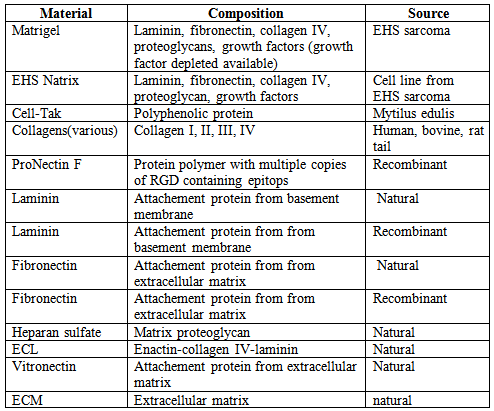
Commercially available matrices such as Matrigel™ (Becton Dickinson) from the Engel breth–Holm–Swarm (EHS) sarcoma, contain laminin, fibronectin, and proteoglycans, with laminin predominating. Other matrix products include Pronectin F (Protein Polymer Technologies), laminin, fibronectin, vitronectin entactin (UBI), heparan sulfate, EHS Natrix (BD Biosciences), ECL (US Biological), and Cell-tak (BD Biosciences). Some of these products are purified, whereas others are a mixture of matrix products that have been poorly characterized and may also contain bound growth factors. If cell adhesion for survival is the main objective, and defined substrates are inadequate, the use of these matrices is acceptable, but if mechanistic studies are being carried out, they can only be an intermediate stage on the road to a completely defined substrate.
Table 2: Examples of some matrix
Interesting facts:
- Collagens are abundantly found structural protein in the human body and accounts for 90% of bone matrix protein content.
- Elastins give elasticity to tissues, allowing them to stretch when needed and then return to their original state.
- Fibronectins bind to ECM macromolecules and facilitate their binding to transmembrane integrins.
- Basal laminae contain distinct adhesion proteins of the laminin family in almost all animals.