Role of matrix in cell growth: Matrix is an insoluble, dynamic gel in the cytoplasm, believed to be involved in cell shape determination and locomotive mechanism, across a solid substrate. It consists of polymeric microtubules, actin microfilaments and intermediate filaments interacting with a number of other proteins.
Extracellular matrix (ECM): The extracellular matrix (ECM) is a part of three connective tissue layers (endomysium, perimysium, and epimysium) surrounding muscle fibres. Extracellular matrix is composed of proteins including collagens and proteoglycans.
Component of extra cellular matrix: ECM is comprised variously of collagen, laminin, fibronectin, hyaluronan and proteoglycans such as beta glycan, decorin, perlecan, and syndecan-1, some of which bind to growth factors or cytokines.
- Proteoglycans in extracellular matrix form a cross-linked meshwork with fibrous proteins
- Some proteins bind multiple other proteins and glycosaminoglycans (fibronectin).
- Integrin is a family of proteins that mediate signalling between cell interior and extracellular matrix
- Mass of interactions between cells and matrix not only anchors cells to matrix but also provides paths that direct migration of cells in developing tissue and (through integrin) conveys information in both directions across plasma membrane. Figure 1 depicts structure of cell matrix.
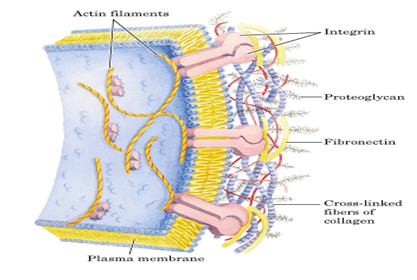
Figure 1: Cell matrix
ECMs are composed of proteins such as collagen and elastin that serve as scaffolds for cells as well as networks of various adhesion ligands and growth factors, which promote cell signalling. ECM is complex in both structure and composition.
Role of matrix: There are some important roles that matrix play in biological system which is described as follows.
- Matrixes are generally used for providing support
- It involve in segregating tissues from one another
- It takes part in regulation of intercellular communication
- Extracellular Matrix cells have been found to cause regrowth and healing of tissue.
- Some time it acts as fibrosis
- The use of ECM constituents can be highly beneficial in enhancing cell survival, proliferation, or differentiation, but unless recombinant molecules are used
- In human foetuses, the extracellular matrix works with stem cells to grow and regrow all parts of the human body and foetus can regrow anything that gets damaged in the womb
- In case of injury repair and tissue engineering , the extracellular matrix serves two main functions
- It prevents the immune system by triggering from the injury and responding with inflammation and scar tissue
- It facilitates the surrounding cells to repair the tissue instead of forming scar tissue
Molecular components: Components of the ECM are produced intracellularly by resident cells and secreted into the ECM through exocytosis. Once secreted, they then aggregate with the existing matrix. The ECM is composed of an interlocking mesh of fibrous proteins and glycosaminoglycans (GAGs).