Areas of action of cyclic AMP:
There are so many application of cAMP for the prevention of several disorders in human beings. Some are shown below:
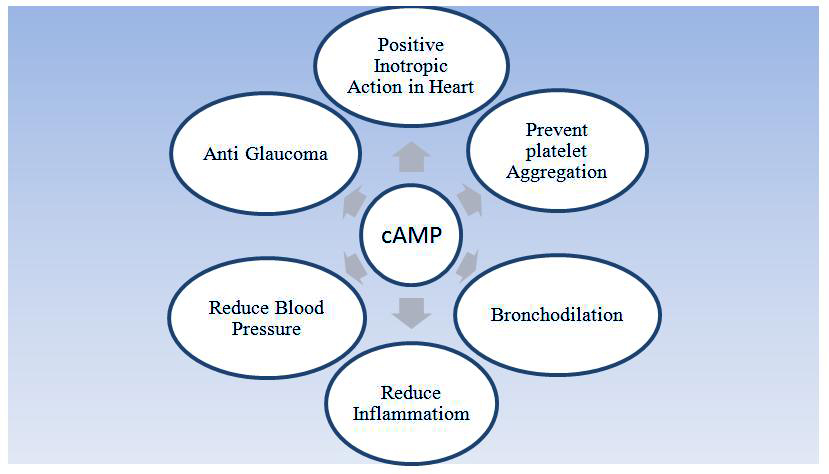
Figure 5: Action of cAMP in our body
Mechanism of Regulation of cAMP: When stimulatory hormone binds to G-protein coupled receptor some conformational changes occur in the receptor by which its unexposed catalytic part gets exposed due to which it can interact and activate G-protein with exchange of GDP by GTP at Gα subunit. Now Gα subunit goes and activates membrane bound adenylyl cyclase that facilitates the conversion of ATP to cAMP. This cAMP is now ready to activate protein kinase A which is involved in phosphorylation of several proteins that takes part in the further cellular responses. At the same time of cAMP production by adenylyl cyclase, the cAMP level is controlled by other enzyme that is called cAMP phosphodiesterase which converts cAMP into 5'-AMP. On the other hand, when inhibitory hormone binds to G-protein coupled receptor, it counters the effect as shown in Figure 6. In this process, the adenylyl cyclase is inhibited because GPCR activates the G protein that contains inhibitory alpha subunit which binds to enzyme and inhibits cAMP production.