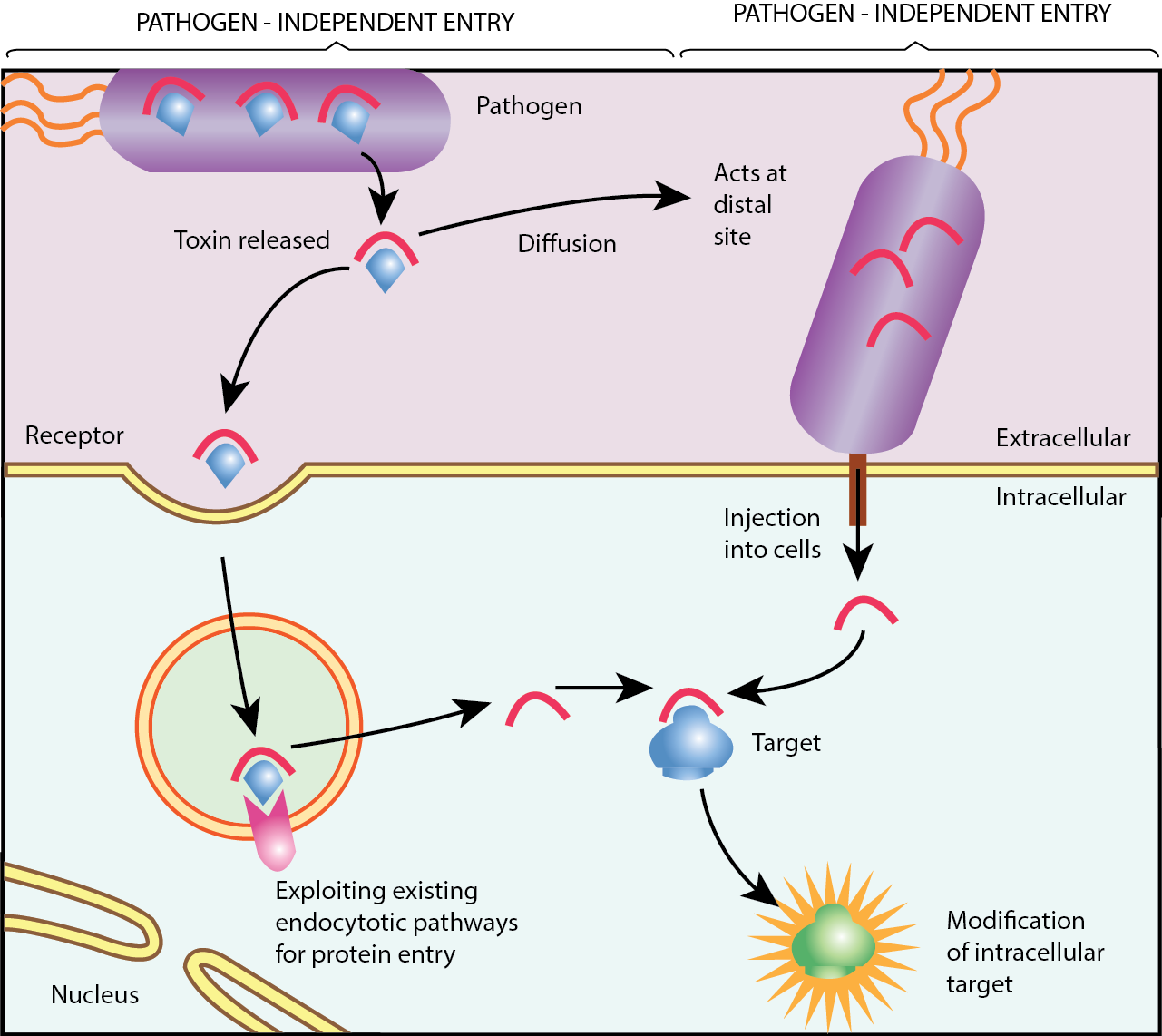
Figure 4: Intracellularly acting bacterial toxins access their substrates within host cells by one of several mechanisms. Some gram-negative pathogens directly inject toxin effectors through flagellar- or pilus-adapted transport machines into eukaryotic cells by Type III or IV secretion systems, respectively. Alternatively, bacteria release intracellular-acting toxins, also called AB toxins, into the host environment where they act locally or diffuse to act distally to the site of colonization. AB toxins commonly exploit endocytic pathways that eukaryotic cells use for importing proteins. Finally, Bordetella adenylate cyclise toxins directly enter the cytosol from the plasma membrane
Toxins Exploit the Acidic Environment of Endosomal Compartments
Some AB toxins like diphtheria, anthrax and the botulinum neurotoxins, exploit the drop in pH to between 5.0 and 6.0 as endocytic vesicles are trafficked from the plasma membrane into the cell. This acidification results in the insertion of B fragments into the membrane and the formation of ion-conducting channels. Partially unfolded A fragments use these B fragment-derived channels as conduits into the cytosol. (Steven et al.,2006).
Toxins Exploit the Sec61 Retro-Translocon in the Endoplasmic Reticulum
The second group of AB toxins includes cholera toxin, shiga toxin, and Pseudomonas aeruginosa exotoxin A and exploit the degradation pathway for misfolded proteins. The secretion pathway is at least partially reversible to the fate of nascent proteins for secretion, enabling several bacterial toxins to travel this “retrograde” pathway from the plasma membrane to the ER lumen through pores to the cytosol. Within the lumen of the ER, the A fragments are transported through an existing membrane complex whose primary protein is Sec61. The B fragments of these toxins bind to receptors to facilitate the trafficking of catalytic A fragments to the ER.