Example: β-PFTs forming large pores: cholesterol dependent cytolysins (CDCs)
CDCs, such as Clostridium perfringens PFO (perfringolysin), recognize cholesterol as a receptor. The molecule is rich in β-sheets and is hydrophilic.
PFO pore formation includes the binding of water-soluble PFO monomers to cholesterol in lipid bilayers, which is mediated by the short hydrophobic undecapeptide loop at the tip of the domain 4. Domains 1, 2, and 4 fit into L-shaped forming a cylindrical structure. Interaction of domain 4 with cholesterol induces a conformational change of domains 3, which are rotated from domains 2 and form a belt in the outside face of the cylinder which promotes in the exposure of hydrophobic residues and the insertion of a transmembrane β-barrel into the lipid bilayer. . And hence larger pores are formed which contain 35-50 monomers.
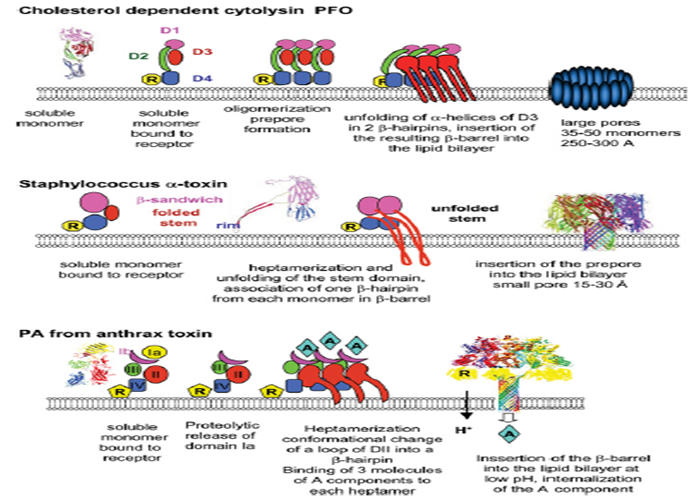
Figure 1: Pore formation of three β -PFTs. Pore formation can occur in the following ways: large pores induced by PFO, an example of a CDC; small pores resulting from heptamerization of Staphylococcus α-toxin; and pores formed by the binding component of anthrax toxin (PA) through endosome membrane, permitting the internalization of the corresponding enzymatic components. All the three types of β-PFTs show a common mode of β-barrel formation and subsequent insertion into lipid bilayers