|
|
Quantum Mechanical Concepts |
 |
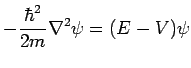
Formation of bands can only be understood on the basis of quantum mechanics. Earlier, we had seen that an object behaves both as particle and as wave. According to de Broglie theory, an electron having a momentum  has an associated wave with a wavelength has an associated wave with a wavelength  . Schrödinger proposed an equation for the wave associated with a particle of mass . Schrödinger proposed an equation for the wave associated with a particle of mass  having a total energy having a total energy  which is moving in a potential which is moving in a potential  . The Schrödinger equation, which is as fundamental to quantum mechanics as Newton's laws are to classical mechanics, is given by . The Schrödinger equation, which is as fundamental to quantum mechanics as Newton's laws are to classical mechanics, is given by |
| |
According to quantum mechanical hypothesis, the wavefunction  is interpreted as the probability amplitude of a particle of energy being at a point is interpreted as the probability amplitude of a particle of energy being at a point  . The square of the wavefunction . The square of the wavefunction  gives the probability density at the point, so that the probability of finding the particle anywhere in space given by gives the probability density at the point, so that the probability of finding the particle anywhere in space given by 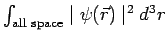 is unity. This is called the normalization of the wavefunction. It is also postulated that the wavefunction and its first derivative are continuous and single valued. is unity. This is called the normalization of the wavefunction. It is also postulated that the wavefunction and its first derivative are continuous and single valued. |