|
Modern electronics, which has revolutionized our way of life, is based on interesting properties of a class of material known as semiconductors.
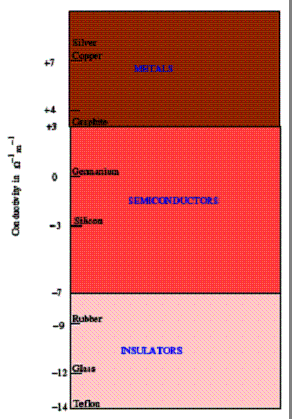
Semiconductors have resistivity values intermediate between those of metals and insulators. While typical metallic resistivity is between  to to  ohm-m, that of silicon, which is a representative semiconductor is ohm-m, that of silicon, which is a representative semiconductor is  ohm-m. Materials with resistivities higher than ohm-m. Materials with resistivities higher than  ohm-m are considered to be insulators. Glass, rubber and many plastics are typical insulators. ohm-m are considered to be insulators. Glass, rubber and many plastics are typical insulators. |
| |
Temperature coefficient of resistivity : |
| |
The resistivity of metals increase with the increase of temperature. This is because with increase in temperature, ions in a solid vibrate more causing electrons to scatter more frequently from them. The semiconductors, on the other hand, have a negative temperature coefficient of resistivity, i.e., their resistivity decreases with increase in temperature. |