|
Free Electron Model of a Metal |
| |
The valence electrons in a metal are detatched from the individual atoms and move in the metal like a gas of free particles. This leaves the atomic cores positively charged. In the free electron model of a metal, it is assumed that this positive charge of the cores is uniformly distributed throughout the metal. Such an assumption essentially removes any details of the crystal structure of the metal. Nevertheless, it is a good starting point in understanding behaviour of electrons in a metal.
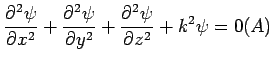
As the interaction between the electrons themselves are also ignored, one can simply consider the motion of a single electron which is moving in a constant potential, which can be conveniently taken to be zero. The electron can be taken to be confined within a box of dimension  within which the potential is constant (taken to be zero) and outside which it is infinite. The Schrödinger equation for the electron within the box is within which the potential is constant (taken to be zero) and outside which it is infinite. The Schrödinger equation for the electron within the box is |
| |
Defining 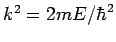 , the equation reads , the equation reads |
![$\displaystyle -\frac{\hbar^2}{2m}\left[\frac{\partial^2\psi}{\partial x^2} +\f... ...partial^2\psi}{\partial y^2} +\frac{\partial^2\psi}{\partial z^2}\right]= E\psi$](imge/img42.png)