|
The equation may be solved by separation of variables by substituting |
| |
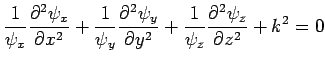
in eqn. (A) and dividing the resulting equation by  . We get . We get |
| |
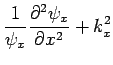
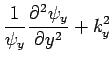
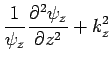
Since  is constant and the first three terms depend upon is constant and the first three terms depend upon  separately, the above equation can be satisfied for all values of only if each of the three terms is constant, i.e. separately, the above equation can be satisfied for all values of only if each of the three terms is constant, i.e. |