| |
Mass - Energy Equivalence |
| |
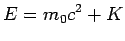
According to Einstein's special theory of relativity, a particle of mass  has equivalently an amount of energy given by the relation has equivalently an amount of energy given by the relation |
| |
where  is the speed of light in vacuum which has a numerical value (approximately) is the speed of light in vacuum which has a numerical value (approximately)  m/s m/s  . The theory of relativity introduces the concept of rest mass , which is the mass an object has when it is at rest relative to an inertial frame. If the mass of an object in such a frame is . The theory of relativity introduces the concept of rest mass , which is the mass an object has when it is at rest relative to an inertial frame. If the mass of an object in such a frame is  , the object has an equivalent energy given by , the object has an equivalent energy given by  . In addition to the rest energy, the object may have a kinetic energy . In addition to the rest energy, the object may have a kinetic energy  because of motion that it has with respect to the inertial frame. The total energy of the object may be written as because of motion that it has with respect to the inertial frame. The total energy of the object may be written as |
| |
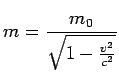
Since the product of mass and the square of the velocity of light has the dimensions of energy, it is possible to express as a product of some mass  times times  , so that the energy of the object may be written as , so that the energy of the object may be written as  , where , where 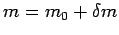 . In this expression is the relativistic mass of the body, which depends both on the rest mass of the body and the state of motion of the body. According to the special theory of relativity, for a body moving with a speed . In this expression is the relativistic mass of the body, which depends both on the rest mass of the body and the state of motion of the body. According to the special theory of relativity, for a body moving with a speed  with respect to an inertial frame, with respect to an inertial frame, |