 |
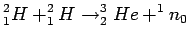
Energy may also be produced by two light nuclei fusing to give a heavier nucleus. This would happen at the initial part of the binding energy curve where the rise in binding energy per nucleon with atomic number is sharp. For instance, if two deuterium (heavy hydrogen) nuclei fuse, we may get |
| |
We can calculate the energy balance as follows |
| |
mass of  He He |
= |
3.016029 |
mass of  n n |
= |
1.008665 |
|
|
------- |
| Total mass of product |
= |
4.024694 |
|
| |
The mass deficit is  u, corresponding to 3.267 MeV. Though energy from fusion can be an enormous source of power because of abundance of deuterium in sea water, fusion of nuclei can be achieved only at extremely high temperatures (of the order of over a million degree !). At such temperatures, no solid container can be used to contain the material used for fusion (the reactants and products would be completely ionized - the mixture of the electrons and the nuclei being in a state of plasma). Controlled thermonuclear fusion has only been possible on a laboratory scale and fusion reactor remains a distant possibility. It may be mentioned that it is the energy released from fusion that keeps our sun (and other stars) hot and luminous. Fusion is possible in sun because of extremely high density of protons at the centre of the sun. u, corresponding to 3.267 MeV. Though energy from fusion can be an enormous source of power because of abundance of deuterium in sea water, fusion of nuclei can be achieved only at extremely high temperatures (of the order of over a million degree !). At such temperatures, no solid container can be used to contain the material used for fusion (the reactants and products would be completely ionized - the mixture of the electrons and the nuclei being in a state of plasma). Controlled thermonuclear fusion has only been possible on a laboratory scale and fusion reactor remains a distant possibility. It may be mentioned that it is the energy released from fusion that keeps our sun (and other stars) hot and luminous. Fusion is possible in sun because of extremely high density of protons at the centre of the sun. |
 H
H 

