| |
A neutron produced in a nuclear reaction must be slowed down before it can be capured by another fuel element. Such thermalization of neutrons is performed by collision with substances which have light masses such as water, heavy water or graphite. These are known as moderators. |
| |
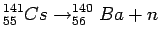
We have seen that control rods of neutron absorbing materials like Cd are inserted to make sure that the reactor does not become supercritical. It is not possible to mechanically control the rate of insertion or withdrawal of control rods which are emitted the instant the nuclear reaction takes place. However, the radioactive decay of the fission fragments produce additional neutrons which are called delayed neutrons. For instance, in the first mentioned fission reaction above, U-236 fragments into  Cs and Cs and  Rb, in addition to releasing two prompt neutrons. These fission fragments themselves are unstable and undergo different types of radioactive decays. Delayed neutrons are associated with fragments which undergo beta decay. In case of Rb, in addition to releasing two prompt neutrons. These fission fragments themselves are unstable and undergo different types of radioactive decays. Delayed neutrons are associated with fragments which undergo beta decay. In case of
 , about 0.03% of the decay is through beta emission, half life against beta decay being 25 seconds , about 0.03% of the decay is through beta emission, half life against beta decay being 25 seconds |
| |
Similarly Rb undergoes beta decay to  Sr in about 1.4% cases producing neutrons with a time lag of about six seconds. The delayed fraction allows mechanical control to be established for controlling both prompt and delayed neutrons. Sr in about 1.4% cases producing neutrons with a time lag of about six seconds. The delayed fraction allows mechanical control to be established for controlling both prompt and delayed neutrons. |