Module 9 : Experiments in Chemistry
Lecture 38 : Titrations : Acid-Base, Redox and Complexometric
 

 38.5 Experiment 4: To determine the composition of a mixture of acetic acid and hydrochloric acid by conductometric titration.


Theory :

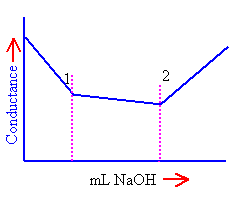
When a mixture containing acetic acid and HCl is titrated against an alkali, strong acid (HCl) will be neutralized first. The neutralization of a weak acid (CH3OOH) commences only after the complete neutralization of strong acid. Thus, the conductance titration curve will be marked by two breaks, the first one corresponds to the equivalence point of HCl and second to that of CH3OOH. In this way, knowing the volume of NaOH used to neutralize HCl and CH3OOH and also knowing the exact strength of NaOH solution, concentration of the acids in the mixture and hence the composition can be calculated.

Procedure:

Take the mixture (say 40 mL 0.1 N CH3COOH + 10 mL 0.1 N HCl) in a small beaker and titrate it against 1N NaOH by addition 0.5 mL (or less volume each time from a micro-burette. Draw a conductance titration curve which will show two breaks.

Volume of NaOH at first break gives the value to neutralize HCl while difference between the two breaks will give equivalent volume of NaOH solution to neutralize CH3COOH.

Figure 38.3:Conductometric titration curve for a mixture HCl and CH3COOH

(a) equivalence point of HCl with NaOH (b) equivalence point of HCl with acetic acid