Module 9 : Experiments in Chemistry
Lecture 38 : Titrations : Acid-Base, Redox and Complexometric
 

38.3 Experiment 2: Acid-base titration using a pH meter

Theory :

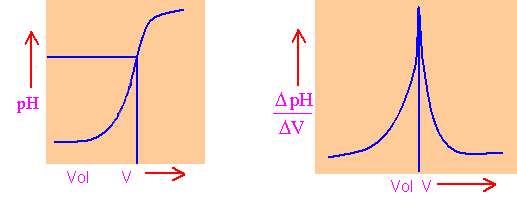
When a base is added (volume, V) to acid, pH increases and reaches to 7.0 at the inflection point. Change in pH is very fast near the inflexion point. Therefore, value of pH / V is the highest at inflexion point. Hence, the end point of an acid base titration could be easily measured by a pH Meter. A representative curve for a pH-metric titration of a strong monobasic acid with strong base is shown below:


  Figure 38.1 (a)                                                            Figure 38.1(b) V = inflexion point


Figure 38.1(a) A graph of pH vs volume of base added (V). (b) The graph of pH / V vs volume of base added, V.

Procedure :

Operation of pH meter

Switch on the instrument five minutes before use, then with the help of selector switch select the pH, mV or stand by mode of the instrument. Stand by means the instrument is not in operation to record pH or mV. Now keep the glass electrode in the standard buffer solution of known pH (say pH = 4) and adjust the pH with the adjustment knob. Take out the glass electrode from this buffer solution and wash it with distilled water, dry it gently with tissue paper and again use another buffer solution of known pH (say 9.0) and check the pH of the buffer. If the pH shown by the instrument is equal to the pH of the second buffer solution then the pH meter is supposed to be standardized and ready to record the pH of an unknown solution. Wash glass electrode with distilled water and dry it with tissue paper each time before putting it in other solution. The glass electrode is delicate and costly and hence the instrument must be handled carefully.

Titration :

Before starting a titration be sure that pH meter is standardized as discussed above.

Now pipette out 25 mL solution of the acid of unknown strength into a 100 mL beaker and keep glass electrode in it in such a position that the bulb of the electrode is well inside the solution but not touching the bottom of the beaker. Note down the initial pH of this solution. Now run in NaOH (base) solution (which has been standardized by N/10 standard solution of oxalic acid using phenolphthalein as indicator) from the burette in small volume (0.5 mL) and gently stir the solution with a glass rod without striking the glass electrode. Determine and record the pH of the solution after each addition and also keep on recording the corresponding volume of base added to the solution. At the end point, there is a sharp change in pH. Continue adding of base and record pH until the pH ceases to rise remarkably. Plot titration curve (pH vs V) and differential titration curve pH/ V or vs V2 and locate the end point to record the volume of the base required for neutralization of the acid of unknown strength taken into a beaker.