Lecture 24 : Applications of Electrode Potentials.
24.3
Determination of the pH of a Solution
The electrode reaction in the case of a hydrogen electrode is H + + e - = ½ H2. Nernst eqn. can be used to calculate the electrode potential of a hydrogen electrode.
EH = Eo (SHE) – ( 0.0591/ 1) log PH21/ 2 / [H+]
(24.8)
Since PH2 = 1 atm and Eo (SHE) = 0, this equation can be written as
EH = 0 - 0.0591 (-log [H+] = - 0.0591 PH2
(24.9)
A hydrogen electrode (EH) dipping into a solution of unknown pH is combined with a reference electrode like the saturated calomel electrode (SCE) and its emf is measured.
Pt | H 2 ( 1 atrn) | [H + ] = x || KCl | Hg2Cl2( s) | Hg
Ecell = E = ER - EL = 0.242 - EH
(24.10)
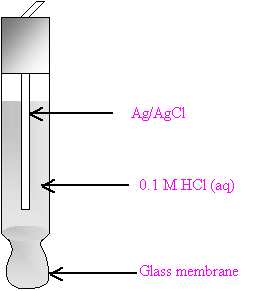
In the above equation, since Eo is known and the Eo (SCE) is + 0.242V, EH can be calculated. This value is substituted in Eqn. (24.9) to obtain the pH of the solution.The commercial pH meters make use of a glass electrode - SCE assembly to measure pH. The glass electrode consists of a thin glass bulb of a special quality glass containing a solution of constant pH into which a reference electrode dips. The cell assembly can be represented as
.......................glass.electrode.................................(S C E)
The potential of a glass electrode depends on the difference in pH on either side of the glass electrode. Since the solution in the glass electrode has a constant pH, the potential depends on the pH of the experimental solution. Before measuring the pH of a given solution, the glass electrode is immersed in a buffer solution (a solution of a constant pH, e.g., acetic acid and sodium acetate) and the pH meter adjusted so as to read the pH of this buffer solution. After washing and rinsing the glass electrode, it is next immersed in the experimental solution and the pH of the solution is read off from the instrument dial or the digital display of the pH meter. The glass electrode is an example of an ion selective electrode. By making suitable changes in the composition of glass, a glass electrode can be made selective to other cations like Na+, K+, NH4+, etc. Compacted discs of silver halides, Ag2S or LaF3 are found to be selective to the respective anions.