Consider a queue that has a process with mean arrival rate of λ actually entering the system. Let N be the mean number of jobs (customers) in the system (waiting and in service) and W be the mean time spent by a job in the system (waiting and in service). Little's Result then states that these quantities will be related to each other asN= λW .
It is important to note that this result will hold for all queues as long as λ is the mean arrival rate of jobs that actually enter the system. Specifically, it may be noted that if the queue has a finite buffer, then arrivals coming when all the buffers are full will not be able to enter the queue and will have to leave without service - in that case, λ should include only those arrivals which are actually allowed into the system.
It is also important to note that the other details of the queue, such as the nature of the arrival process or service times, number of servers or waiting positions and the service discipline followed would not change this result. Little's result holds for virtually all types of queueing situations.
Little's Result will also apply between Nq the mean number of jobs waiting in the queue (not including the one that may be in service) and Wq the mean time spent by a job waiting in the queue prior to service, i.e.Nq= λWq
| N = λW | (3.1) |
| Nq= λWq | (3.2) |
A graphical illustration of Little's Result is given below. This is used in the subsequent slide to give an informal verification for this result. Note that Little's Result is just a simple "book keeping" type of result which is why it holds for all queueing situations, regardless of the actual details of the queue.
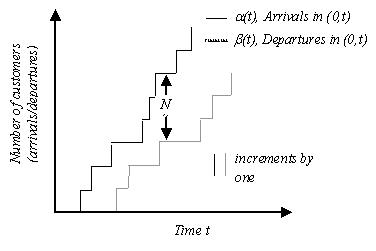 |
The figure given above, shows how the number in the system N=N(t) varies as a function of time in relation to α(t), the number of arrivals till time t, and β(t), the number of departures till time t.