ueues with Poisson Arrivals and Exponentially Distributed Service Times
This module discusses queues where the arrival process can be described as a Poisson process (i.e. with exponentially distributed random inter-arrival times) and where the service time durations are also random variables with exponential distributions.
The memory-less property of the exponential distribution makes these queues easy to analyze. Just as we did in Module 2, the analysis of these queues at equilibrium may be done by using their state transition diagram with the state represented by the number in the system. Solving the balance equations with the appropriate normalization condition would then lead to the desired equilibrium state probabilities.
We start this module by introducing a useful notation which allows a compact representation for the queue. This is known as Kendall's Notation for queues and is given in the next slide.
Kendall's Notation for Queues
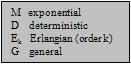
This is a shorthand notation of the type A/B/C/D/E
where A, B, C, D, E describe the queue. This notation may be easily applied to cover a large number of simple queueing scenarios. The various standard meanings associated with each of these letters are summarized below.
Kendall's Notation for Queues |
A/B/C/D/E |
A represents the Inter-arrival Time distribution B represents the Service Time distribution |
 |
 |
 |
C gives the Number of Servers in the queue
D gives the Maximum Number of jobs that can be there in the system counting both those who are waiting and the ones in service). If this is not given then the default value of infinity (∞) is assumed implying that the queue has an infinite number of waiting positions
E represents the Queueing Discipline that is followed. The typical ones are First Come First Served (FCFS), Last Come First Served (LCFS), Service in Random Order (SIRO) etc.. If this is not given then the default queueing discipline of FCFS is assumed.
| Example: M/M/1 or M/M/1/∞ | Single server queue with Poisson arrivals, exponentially distributed service times and infinite number of waiting positions . Note that exponentially distributed inter-arrival times imply a Poisson arrival process. Since the service discipline is not specified, FCFS service is assumed. |