| 26.8 Short-Circuit Power Dissipation |
| The short-circuit power dissipation is given by |
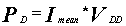 |
(Eq 26.13) |
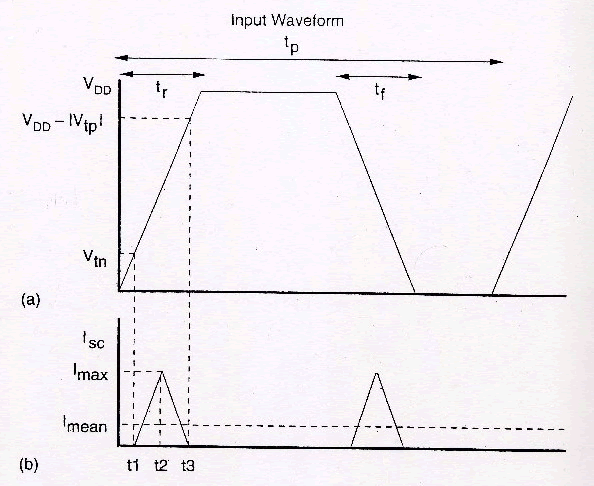
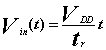
| For the input waveform shown in Fig 26.81a, which depicts the short-circuit (Fig26.81b) in an unloaded inverter, |
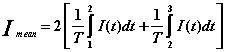 |
(Eq 26.14) |
assuming that  and and  and that the behavior is symmetrical around and that the behavior is symmetrical around  . . |
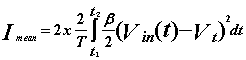 |
| with |
 |
 |
 |
| |
|
| |
Thus for an inverter without load, assuming that  , , |
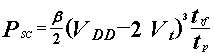 |
where  is the period of the waveform. This derivation is for an unloaded inverter. It shows that the short-circuit current is dependent on is the period of the waveform. This derivation is for an unloaded inverter. It shows that the short-circuit current is dependent on  and the input waveform rise and fall times. Slow rise times on nodes can result in significant (20%) short-circuit power dissipation for loaded inverters. Thus it is good practice to keep all edges fast if power dissipation is a concern. As the load capacitance is increased the signifance of the short-circuit dissipation is reduced by the capacitive dissipation and the input waveform rise and fall times. Slow rise times on nodes can result in significant (20%) short-circuit power dissipation for loaded inverters. Thus it is good practice to keep all edges fast if power dissipation is a concern. As the load capacitance is increased the signifance of the short-circuit dissipation is reduced by the capacitive dissipation  . . |
|