The Convolution Integral
We now want to find the response
for an arbitrary continuous time signal as the superposition
of scaled and shifted pulses just as we did for discrete
time signal. For a continuous LSI system, let h(t)
be the response to the unit impulse signal. Then,
by additivity,
( Note : We can perform additivity on infinite terms only if the sum/integral converges.
)
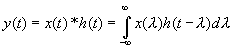
This is known as the continuous
time convolution of x(t) and h(t). This gives the
system response y(t) to the input x(t) in terms of
unit impulse response h(t). The convolution of two
signals h(t) and x(t) will be represented symbolically
as
where as previously seen,
To explain this graphically,
Consider the following input which
(as explained above) can be considered to be an approximation
of a series of rectangular impulses. And it can be
represented using the convolution sum as

Hence, by merely knowing the impulse
response one can predict the response of the signal
x(t) by using the given formula for convolution.