UV-VIS Spectroscopy:
It refers to absorption spectroscopy or reflectance spectroscopy in the ultraviolet-visible spectral region. In UV-VIS spectroscopy, a beam of electromagnetic radiation passes through a sample. While much of the radiation passes through the sample without a loss in intensity, the radiation's intensity is attenuated at selected wavelengths, resulting in the process called absorption.
For absorption, two general conditions must be satisfied:
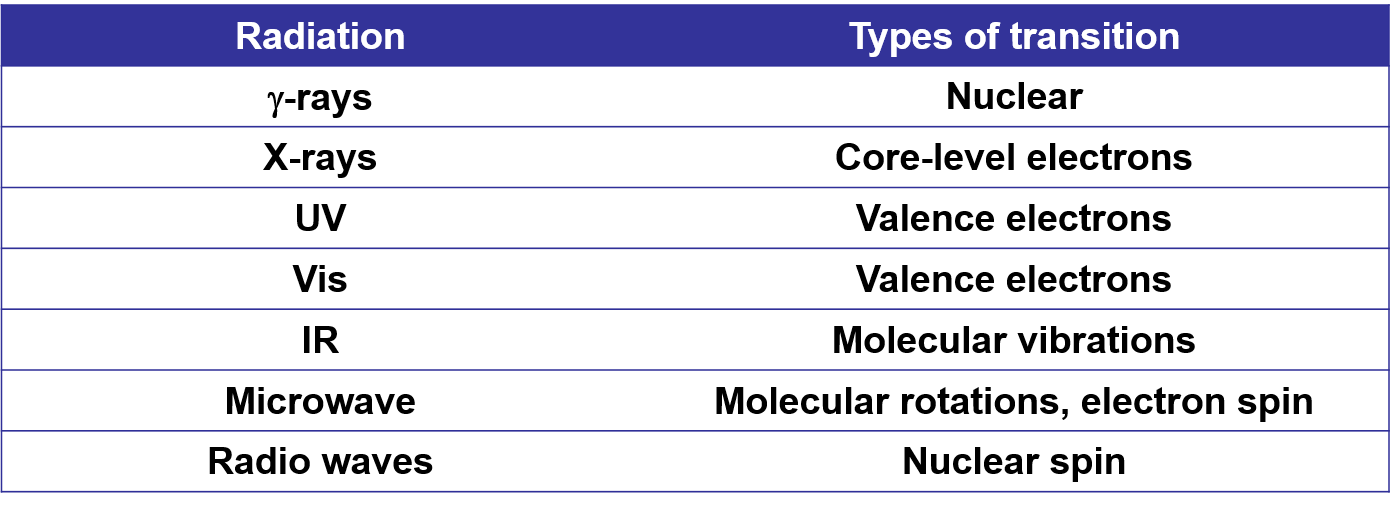
(1) A mechanism by which the radiation interacts with the sample such that the absorption of a photon changes the energy of the valence electrons. Table 1 summarizes various types of atomic and molecular transitions by the electromagnetic radiation.