In automated industrial processes, it is always essential to keep the process variables such as temperature, flow rate, system pressure, fluid level, etc. at the desired value for safety and economical operation. Consider an example where the flow of water through a pipe has to be kept constant at some predetermined value (Fig. 6.5.1). Let the value of flow to be measured is ‘V' (process variable PV). This flow rate is compared with the required flow value say ‘V 1 ' (set point SP). The difference between these two values is the error which is sent to the controller. If any error exists, the controller adjusts the drive signal to the actuator, informing it to move the valve to give the required flow (zero error). This type of control system is called closed loop control system. It mainly includes a controller, actuator and a measuring device.
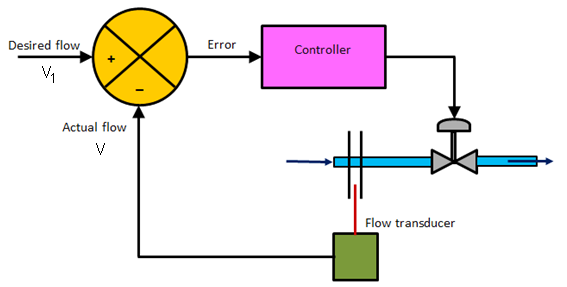
Fig. 6.5.1 Closed loop control system
The control can be achieved by using control electronics or by pneumatic process control. The pneumatic systems are quite popular because they are safe. In the process industries like refinery and chemical plants, the atmosphere is explosive. Application of electronics based systems may be dangerous in such cases. Since the pneumatic systems use air, there are very scant chances of any fire hazards. Even though electrical actuators are available, but most of the valves employed are driven by pneumatic signals.