3. Thermistors
Thermistors follow the principle of decrease in resistance with increasing temperature. The material used in thermistor is generally a semiconductor material such as a sintered metal oxide (mixtures of metal oxides, chromium, cobalt, iron, manganese and nickel) ordoped polycrystalline ceramic containing barium titanate (BaTiO3) and other compounds. As the temperature of semiconductor material increases the number of electrons able to move about increases which results in more current in the material and reduced resistance.Thermistors are rugged and small in dimensions. They exhibit nonlinear response characteristics.
Thermistors are available in the form of a bead (pressed disc), probe or chip. Figure 2.5.4 shows the construction of a bead type thermistor. It has a small bead of dimension from 0.5 mm to 5 mm coated with ceramic or glass material. The bead is connected to an electric circuit through two leads. To protect from the environment, the leads are contained in a stainless steel tube.
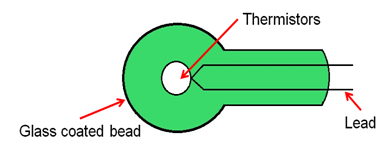
Figure 2.5.4 Schematic of a thermistor
Applications of Thermistors
- To monitor the coolant temperature and/or oil temperature inside the engine
- To monitor the temperature of an incubator
- Thermistors are used in modern digital thermostats
- To monitor the temperature of battery packs while charging
- To monitor temperature of hot ends of 3D printers
- To maintain correct temperature in the food Handling and processing industry equipments
- To control the operations of consumer appliances such as toasters, coffee makers, refrigerators, freezers, hair dryers, etc.