Temperature conveys the state of a mechanical systemin terms of expansion or contraction of solids, liquids or gases, change in electrical resistance of conductors, semiconductors and thermoelectric emfs. Temperature sensors such as bimetallic strips, thermocouples, thermistors are widely used in monitoring of manufacturing processes such as casting, molding, metal cutting etc. The construction details and principle of working of some of the temperature sensors are discussed in following sections.
1. Bimetallic strips
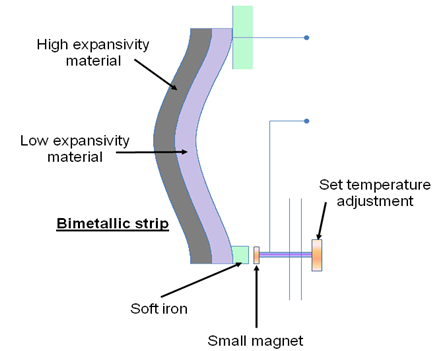
Figure 2.5.1 Construction and working of Bi-metallic strip
Bimetallic strips are used as thermal switch in controlling the temperature or heat in a manufacturing process or system. It contains two different metal strips bonded together. The metals have different coefficients of expansion. On heating the strips bend into curved strips with the metal with higher coefficient of expansion on the outside of the curve. Figure 2.5.1 shows a typical arrangement of a bimetallic strip used with a setting-up magnet. As the strips bend, the soft iron comes in closer proximity of the small magnet and further touches. Then the electric circuit completes and generates an alarm. In this way bimetallic strips help to protect the desired application from heating above the pre-set value of temperature.
2. Resistance temperature detectors (RTDs)
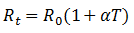
RTDs work on the principle that the electric resistance of a metal changes due to change in its temperature. On heating up metals, their resistance increases and follows a linear relationship as shown in Figure 2.5.2. The correlation is
 (2.5.1)
Where Rt is the resistance at temperature T (°C) and R0 is the temperature at 0°C and α is the constant for the metal termed as temperature coefficient of resistance. The sensor is usually made to have a resistance of 100 Ω at 0°C