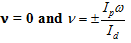
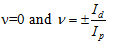
Exercise 5.12 A shaft of modulus of rigidity EI, length l, and negligible mass is simply supported at both ends. At one end it carries a thin disc of mass, m, and moment of inertia, Id, about the diameter. This disc is very close to the bearing: assume it to be at the bearing, so that it can tilt, but not displace its centre of gravity. (a) For the case of no rotation, find the natural frequency. (b) Derive the general frequency equation in terms of a rotational speed, ω, and the whirl frequency, v; make this equation dimensionless in terms of  and
and  -functions,

Solve for the non-dimensional whirl frequency in terms of the non-dimensional spin frequency ω; (c) Is the critical speed exist for the above system. [Answers: (a) 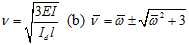 (c) Does not exist].
Exercise 5.13 For the synchronous backward whirl condition, derive the frequency equation in terms of the critical speed function  , and the disc effect
  . Show a plot of
  versus μ and show limiting cases. [Hint: The direction of gyroscopic moment would be opposite to that of the synchronous forward whirl conditions. Rest of the analysis would be same as discussed in section5.2.1. Answer:
 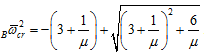 . For limiting case (i) μ = 0,
  = 3 (ii) μ → ∞ → 0].
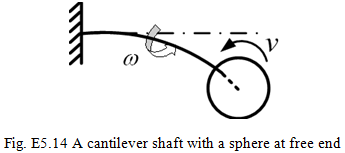
Exercise 5.14 Obtain the transverse critical speed for the forward synchronous motion of a cantilever shaft with a sphere (of the mass m, and the radius, r) at the free end (Fig. E5.14). It is assumed that the shaft free-end is connected to the centre of the sphere, and it is not interfering motion of the sphere at any other point of the sphere. The shaft modulus of rigidity of the shaft is EI and its length is l. The spin speed is ω and whirl frequency is  . Discuss the limiting cases (i) when radius is zero and (ii) it is infinity. Consider the gyroscopic effects. For the sphere we have: Id = Ip = 2mr2/5. [Hint: Please note that a sphere has same mass moment of inertia about any diametral axis, Ip= Id].
Exercise 5.15 Consider an industrial fan that rotates with a very high speed and its overall body has a slow precession about its centre of gravity due to flexible supports. Consider gyroscopic effect and obtain the forward and backward critical speeds of the fan rotor system. The effective torsional stiffness of the support is 1 MN/m and the effective diametral and polar mass moments of inertia of the fan are 1 kg-m2 and 0.1 kg-m2, respectively.
Exercise 5.16 Obtain the frequency equation by using the dynamic method for a general motion (i.e., asynchronous motion) of a single disc rotor system and compare the same with the frequency equation obtained using the quasi-static method discussed in the class. Use software which can handle symbolic form of expressions (e.g., Mathematica or Matlab) if required during obtaining determinate of a matrix in the symbolic form. Obtain closed form expressions of critical speeds for the forward and backward whirl conditions by the frequency equation so obtained.
Exercise 5.17 Derive critical speed expression of a long stick rotor for the backward synchronous whirl based on the centrifugal force concept with the help of neat diagrams and discuss the same for various disc effect parameters with the help of plots.
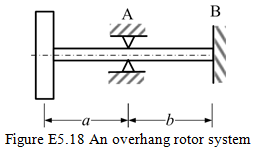
Exercise 5.18 Obtain transverse natural frequencies of a rotor system as shown in Figure E5.18. The mass of the thin disc is m = 5 kg and the diametral mass moment of inertia is Id = 0.02 kg-m2. Lengths of the shaft are a = 0.3 m and b = 0.7 m. The diameter of the shaft is 10 mm. Bearing A has the roller support and Bearing B has the fixed support condition. Neglect the mass of the shaft, however, consider the gyroscopic effect of the disc. E = 2.1 (10)11 N/m2. Compare and discuss the results with the case of without gyroscopic couple.
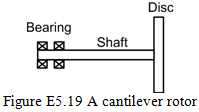
Exercise 5.19 Obtain the forward and backward transverse whirl frequencies corresponding to thrice the rotor speed for a general motion of a rotor as shown in Figure E5.19. The rotor is assumed to be fixed supported at one end. Take the mass of the disc m = 2 kg, the polar mass moment of inertia Ip = 0.01 kg-m2 and the diametral moment of inertia Id = 0.005 kg-m2. The shaft is assumed to be massless, and its length and diameter are 0.2 m and 0.1 m, respectively. Take the shaft Young’s modulus E = 2.1 X 10¹¹ N/m2.
Exercise 5.20 Choose a single correct answer from multiple choice answers:
- For a symmetrical shaft whether gyroscopic moment may give rise to instability?
- True
- False
- A cantilever rotor, with a single disc and massless shaft, can have how many transverse natural frequencies?
- 1
- 2
- 3
- 4
- more than 4
- Because of the gyroscopic moment natural frequencies depend upon the spin speed of the shaft.
- True
- False
- In a general motion of a rotor, the whirl frequency and the spinning frequency (speed) are always same.
- True
- False
- Because of the gyroscopic moment the whirl natural frequency of a rotor
- increases only
- decreases only
- either increases or decreases
- remains constant
- increases and decreases, simultaneously.
- For a rotor system, with gyroscopic effects and without damping, natural whirl frequencies would be pure imaginary.
- True
- False
- (vii) For a rotor system, with gyroscopic effects and with damping, natural whirl frequencies would be pure imaginary.
- True
- False
- (viii) Because of gyroscopic moment in the forward whirl motion, the effective stiffness of the shaft increases.
- True
- False
- (ix) Because of gyroscopic moment in the backward whirl motion, the effective stiffness of the shaft increases.
- True
- False
- (x) Because of the gyroscopic moment in a rotor system with damping, it will never be unstable.
- True
- False
- A Campbell diagram is a diagram between
- the amplitude versus the excitation frequency
- the synchronous whirl natural frequency versus the excitation frequency
- the anti-synchronous whirl natural frequency versus the excitation frequency
- the asynchronous whirl natural frequency versus the excitation frequency
- Because of the gyroscopic effect, a rotor forward natural whirl frequency
- remains same
- decreases
- increases
- no definite trend
- For a cantilever rotor with a long stick (with diameter D and length b) for the pure tilting motion, the gyroscopic couple will be absent, if
- b < D
- b = D

- b = 1..866D
- Due to gyroscopic effects
- Frequencies of the forward and backward whirls become faster as compared to the whirling frequency without gyroscopic effect.
- Frequencies of the forward and backward whirls become slower as compared to the whirling frequency without gyroscopic effect.
- Frequencies of the forward and backward whirls become slower and faster, respectively, as compared to the whirling frequency without gyroscopic effect.
- Frequencies of the forward and backward whirls become faster and slower, respectively, as compared to the whirling frequency without gyroscopic effect.
- For a general motion of a rotor with gyroscopic effect, for a special case when the elastic coupling, α, is the absent the square of backward critical speed corresponding to pure rotational motion would be (where the disc effect

- 1/µ
- 1/µ2
- 1/(2µ)2
- 1/(3µ)
- For a long rigid rotor mounted on anisotropic elastic bearings with no cross coupling, the following mode of whirl is possible
- Purely translation and purely conical
- Purely translation only
- Purely conical only
- Combination of translation and conical
- While considering gyroscopic effect in asynchronous pure rotational motion of a rotor mounted on some spring flexible support, if the support spring breaks suddenly, then the whirl frequencies would be


Exercise 5.21 Briefly describe the following
- Synchronous forward whirl and asynchronous forward whirl.
- Natural whirl frequency and critical speed in the case of rotor systems with gyroscopic effect.