 ...........................................................(2.5.15)
As the potential energy does not depend on velocity, using Lagrangian  , Eq. (2.5.15) can be rewritten as
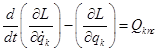 .............................................................................................(2.5.16)
Using dissipation energy D , this equation further can be written as
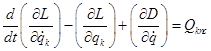 ................................................................................ (2.5.17)
Using both external forces and moments one may write the generalized force as
 .............................................(2.5.18)
Mi is the vector representation of the externally applied moments,  is the system angular velocity about the axis along which the considered moment is applied.
- -- Lagrange equation can be used for any discrete system whose motion lends itself to a description in terms of generalized coordinates, which include rigid bodies.
-- can be extended to distributed parameter system, but such system, they are not as versatile as the extended Hamilton's Principle
Let us take some examples to derive the equation of motion using Lagrange principle.
Example 2.5.1: Derive the equation of motion of a spring-mass-damper system with spring force given by  and damping force given by
 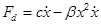 . The external force acting on the system is given by
  . Consider mass of the system as m and displacement from the static equilibrium point as x.
Solution: In this single degree of freedom system one can take x as the generalized co-ordinate. From the given expressions for different forces acting on the system, the expressions for kinetic energy T , potential energy V, dissipation energy D can be given by the following expressions.
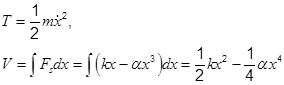 .............................................................. (2.5.19)
 ........................................................................(2.5.20)