Introduction
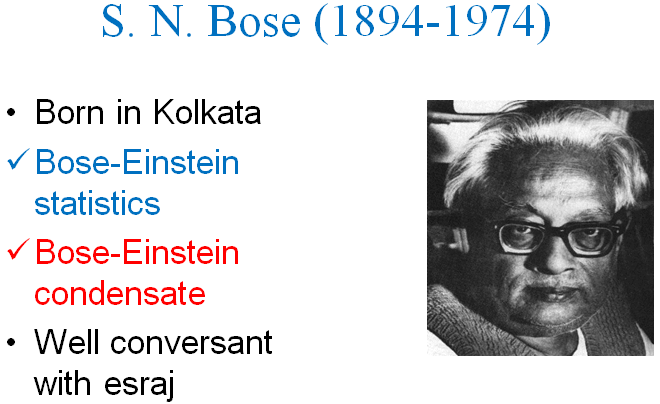
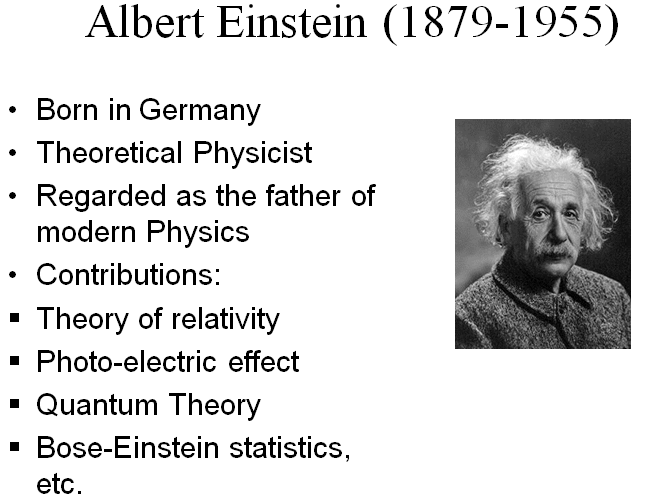
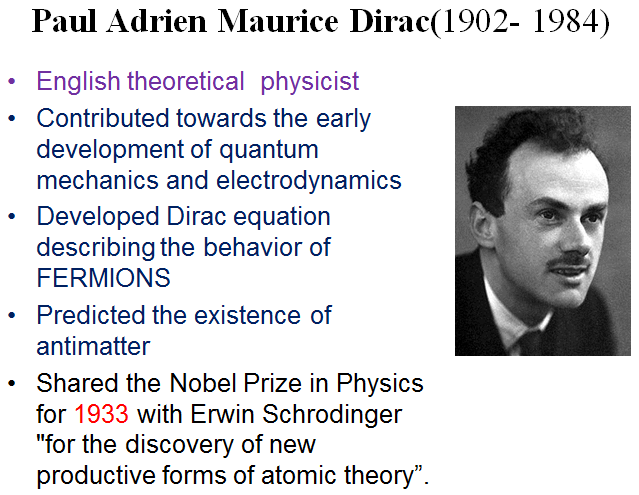
Statistical thermodynamics was developed by Boltzmann in Germany and concurrently by Gibbs in USA. The theory was modified to some extent later on by S. N. Bose (India, 1894-1974), Einstein (Germany, 1879-1955), Enrico Fermi (Italy, 1901-1954) and Paul A. M. Dirac (UK, 1902-1984). It is applicable to molecules, photons, elastic waves of solids, abstract entities such as wave function, electrons, boson, meson, etc.

Classical mechanics applies to large number of particle collections (order of Avogadro's number A = 6.02626 X 10²³ ). Molecules being large in number, average properties are calculated without knowing about the individual molecule. Further, classical thermodynamics assumes the flow field to be continuum and conservative. But it fails to predict the value of properties like specific heat. In case of kinetic theory, number of molecules per cubic centimeter is 1020 in a chamber. To know velocity vector ( x, y, z) direction with N particles, we require to solve 3N X 1020 second order equations. Each molecule is to be considered. Thus it is a formidable task to solve such huge number of equations.
Statistical thermodynamics deal with the evaluation thermodynamics properties in terms of entropy.
All the models or relations developed in statistical thermodynamics aim at finding the entropy .
Study of relationships among the thermodynamic properties alone is generally the topic of classical thermodynamics .
On the other hand, establishing relationships between non thermodynamic and thermodynamic properties of matter in equilibrium states is the task of statistical thermodynamics .
Thermodynamic (macroscopic) and Non-Thermodynamic (microscopic) Properties
A property of matter is any characteristic, which can distinguish a given quantity of a matter from another. These distinguishing characteristics can be classified in several different ways, but for the convenience, it can be divided into thermodynamic and non-thermodynamic properties.
The non-thermodynamic properties describe the characteristics of the "ultimate particles" of matter. An ultimate particle, from a thermodynamic viewpoint, is the smallest subdivision of a quantity of matter, which does not undergo any net internal changes during a selected set of processes, which alter properties of the entire quantity. The ultimate particles are generally considered to be molecules or atoms, or in some cases groups of atoms within a molecule. Because it has no internal changes, an ultimate particle can always be regarded as a rigid mass. Its only alterable distinguishing characteristics which could possibly be detected, if some experimental procedure could do so, are its position and its motion. As a result, the fundamental properties of this particle, which cannot be calculated or derived from any others, consist only of its mass and shape plus the vectors or coordinates needed to describe its position and motion . It is convenient to combine the mass and motion characteristics and represent them as a momentum property. These fundamental characteristics, mass, position, and momentum, are called "microstate" properties and as a group they give a complete description of the actual behavior of an ultimate particle.