It is important to see objects and practices as gaining significance, meaning or value through the play or criss-crossing of discourses.
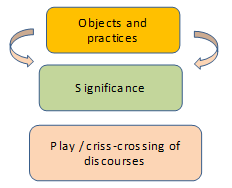
If somebody proposes that culture is textual, we may strongly react to that. We are not saying that culture is only textual, or solely marks on the page. The argument is that the articulation of culture, of objects and practices and therefore their meaning generation and significance happen because of discourse. To quote from Barker,
“Culture can be regarded as regulated maps of meaning. These maps are constituted by criss-crossing discourses through which objects and practices acquire significance. Culture is a snapshot of the play of discursive practices within a given time and space”.
The important thing is that this ‘snapshot' is not fixed. Every different moment can generate different snapshots. Likewise the articulation of culture as the regulated maps of meanings is ever changing, dynamic and therefore temporary.
Barker further says:
“The machinery and operations of language are central concerns, and problems, for cultural studies. Indeed, the investigation of culture has often been regarded as virtually interchangeable with the exploration of meaning produced symbolically through signifying systems that work like a language”.
The word machinery is used as a procedure of language, that is, looking at language as a system with different units that go on to make the system called language. Culture works through signifying systems, like a language. And like language, culture is the selection and organization of signs.