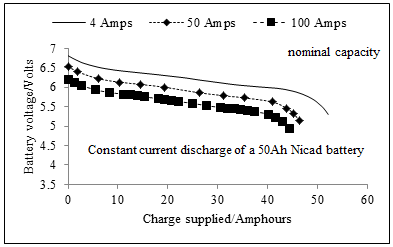
Fig. 3 Showing the voltage of a 6V NiCad traction battery as it discharges for three different currents. These are simulated results using the model described in the text
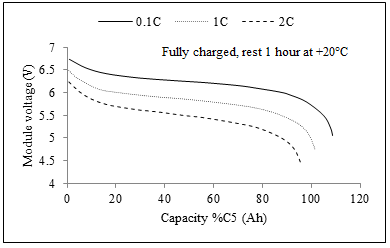
Fig. 4 Results similar to those of Figure m, but these are measurements from a real battery.
- Simulation a battery at a set power
When making a vehicle goes at a certain speed, then it is a certain power that will be required from the motor. This will then require a certain electrical power from the battery. It is thus useful to be able to simulate the operation of a battery at a certain set power, rather than current. The first step is to find an equation for the current I from a battery when it is operating at a power P Watts. In general we know that:
| P = V X I | .........................................................................(13) |
If we then combine this with the basic equation for the terminal voltage of a battery, which we have written as equation 1 , we get:
| P = V X I = (E - IR) X I = EI - RI2 | .......................................................................(14) |
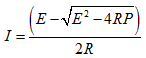
This is a quadratic equation for I. The normal useful solution6 to this equation is:
 |
....................................................................(15) |
This equation allows us to easily use MATLAB or similar mathematical software to simulate the constant power discharge of a battery. The graph of voltage against time is shown in Fig. 5. When we come to simulate the battery being used in a vehicle, the issue of regenerative braking will arise. Here a certain power is dissipated into the battery. If we look again at Fig. 5, and consider the situation that the current I is flowing into the battery, then the equation becomes:
| V = E + IR | ............................................................(16) |
If we combine equation 16 with the normal equation for power we obtain:
| P = V X I = (E + IR) X I = EI + RI2 | .........................................................(17) |
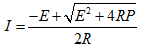
The ‘sensible’, normal efficient operation, solution to this quadratic equation is:
 |
............................................................(18) |
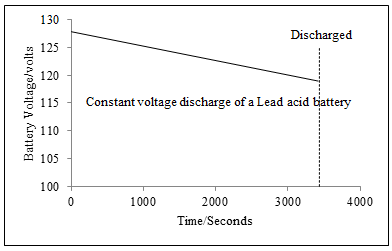
Fig. 5 Graph of voltage against time for a constant power discharge of a lead acid battery at 5000 W. The nominal ratings of the battery are 120 V, 50 Ah