 |
Adhesion, Dynamic wheel radius and slip
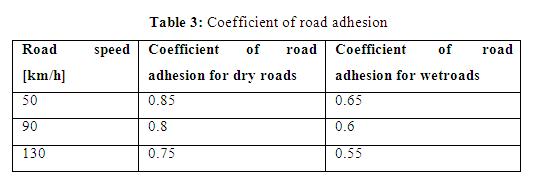
When the tractive effort of a vehicle exceeds the maximum tractive effort limit imposed by the adhesive capability between the tyre and ground, the driven wheels will spin on the ground. The adhesive capability between the tyre and the ground is the main limitation of the vehicle performance especially when the vehicle is driven on wet, icy, snow covered or soft soil roads.
The maximum tractive effort on the driven wheels, transferred from the power plant through the transmission should not exceed the maximum values given by equation 25 and equation 27. Otherwise, the driven wheels will spin on the ground, leading to vehicle instability. The slip between the tyres and the surface can be described as:
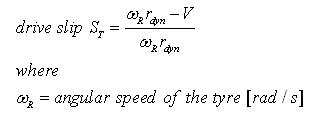 (28)
(28)
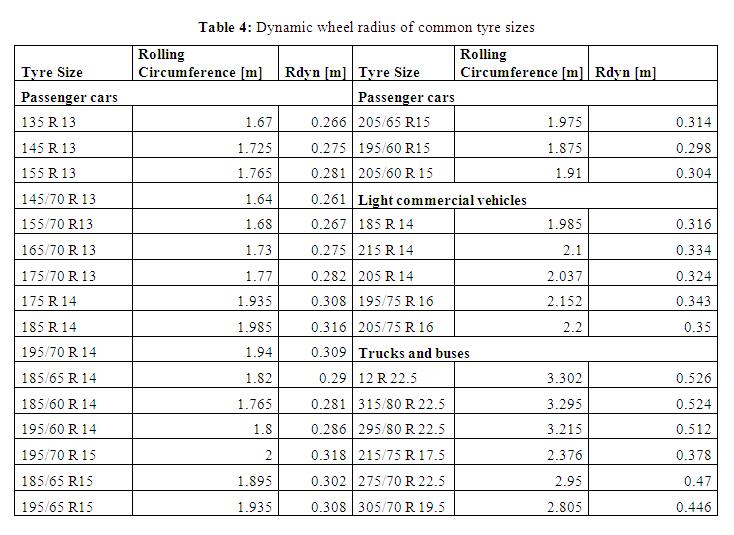
The dynamic wheel radius (rdyn) is calculated from the distance travelled per revolution of the wheel, rolling without slip. The dynamic wheel radius is calculated from a distance travelled at 60km/h. The increasing tyre slip at higher speeds roughly offsets the increase in rdyn. The values of rdyn for different tyre sizes are given in table 4.
Table 4: Dynamic wheel radius of common tyre sizes
 |
References:
[1] M. Ehsani, Modern Electric, Hybrid Electric and Fuel Cell Vehicles: Fundamentals, Theory and Design , CRC Press, 2005
Suggested Reading:
[1] I. Husain, Electric and Hybrid Electric Vehicles , CRC Press, 2003
[2] C. C. Chan and K. T. Chau, Modern Electric Vehicle Technology , Oxford Science
Publication, 2001
[3] G. Lechner and H. Naunheimer, Automotive Transmissions: Fundamentals, Selection, Design and Application , Springer, 1999