Acceleration resistance
In addition to the driving resistance occurring in steady state motion, inertial forces also occur during acceleration and braking. The total mass of the vehicle and the inertial mass of those rotating parts of the drive accelerated or braked are the factors influencing the resistance to acceleration:
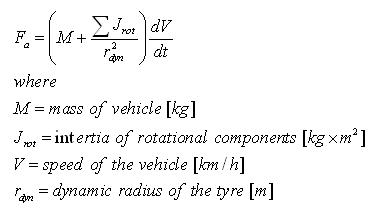 (12)
(12)
The rotational component is a function of the gear ratio. The moment of inertia of the rotating drive elements of engine, clutch, gearbox, drive shaft, etc., including all the road wheels are reduced to the driving axle. The acceleration resistance can be expressed as
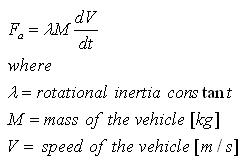 (13)
(13)
Total driving resistance
The traction force (Ft) required at the drive wheels is made up of the driving resistance forces and is defined as
 (14)
(14)
Substituting the values of all the forces in equation 14, gives
 (15)
(15)
The equation 15 may be used to calculate the power required (Preq):
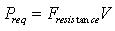 (16)
(16)
Dynamic equation
In the longitudinal direction, the major external forces acting on a two axle vehicle (Figure 1) include:
- • the rolling resistance of the front and rear tires (Frf and Frr), which are represented by rolling resistance moment, Trf and Trr
• the aerodynamic drag (Fw)
• grade climbing resistance (Fg)
• acceleration resistance (Fa)
The dynamic equation of vehicle motion along the longitudinal direction is given by
 (17)
(17)