Using the Newton's second law of motion, the vehicle acceleration can be expressed as
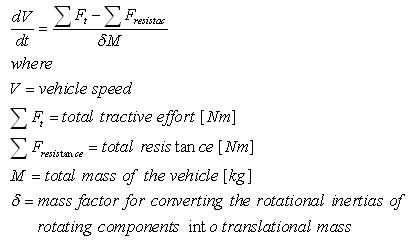 (1)
(1)
Rolling resistance
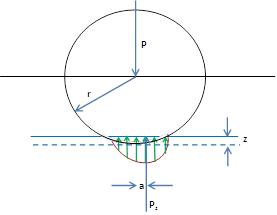
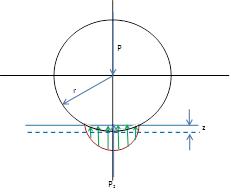
The rolling resistance of tires on hard surfaces is due to hysteresis in the tire material. In Figure 2 a tire at standstill is shown. On this tyre a force ( P ), is acting at its centre. The pressure in the contact area between the tire and the ground is distributed symmetrically to the centre line and the resulting reaction force (Pz) is aligned along P .
|
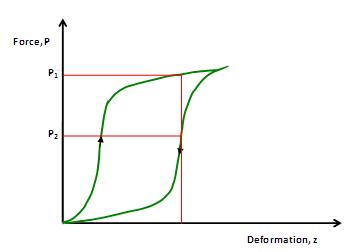
The deformation, z, versus the load P, in the loading and unloading process is shown in Figure 3. From this figure it can be seen that, due to the hysteresis, the force (P) for the same deformation (z) of the tire material at loading is greater than at during unloading. Hence, the hysteresis causes an asymmetric distribution of the ground reaction forces.
|
The scenario of a rolling tire is shown in Figure 4. When the tire rolls, the leading half of the contact area is loading and the trailing half is unloading. Thus, the pressure on the leading half is greater than the pressure on the trailing half (Figure 4a). This phenomenon results in the ground reaction force shifting forward. The shift in the ground reaction force creates a moment that opposes rolling of the wheels. On soft surfaces, the rolling resistance is mainly caused by deformation of the ground surface, (Figure 4b). In this case the ground reaction force almost completely shifts to the leading half.
Figure 4a: Force acting on a tyre vs. deformation in loading and unloading on a hard surface |