Introduction
The fundamentals of vehicle design involve the basic principles of physics, specially the Newton's second law of motion. According to Newton's second law the acceleration of an object is proportional to the net force exerted on it. Hence, an object accelerates when the net force acting on it is not zero. In a vehicle several forces act on it and the net or resultant force governs the motion according to the Newton's second law. The propulsion unit of the vehicle delivers the force necessary to move the vehicle forward. This force of the propulsion unit helps the vehicle to overcome the resisting forces due to gravity, air and tire resistance. The acceleration of the vehicle depends on:
• the power delivered by the propulsion unit
• the road conditions
• the aerodynamics of the vehicle
• the composite mass of the vehicle
In this lecture the mathematical framework required for the analysis of vehicle mechanics based on Newton's second law of motion is presented. The following topics are covered in this lecture:
• General description of vehicle movement
• Vehicle resistance
• Dynamic equation
• Tire Ground Adhesion and maximum tractive effort
General description of vehicle movement
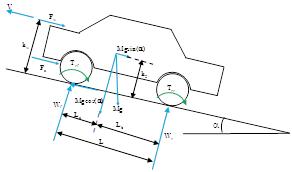
The vehicle motion can be completely determined by analysing the forces acting on it in the direction of motion. The forces acting on a vehicle, moving up a grade, are shown in Figure 1. The tractive force (Ft) in the contact area between the tires of the driven wheels and the road surface propels the vehicle forward. The tractive force (Ft) is produced by the power plant and transferred to the driving wheels via the transmission and the final drive. When the vehicle moves, it encounters a resistive force that tries to retard its motion. The resistive forces are
• Rolling resistance
• Aerodynamic drag
• Uphill resistance
 |
|
Figure 1: Forces acting on a vehicle going uphill |