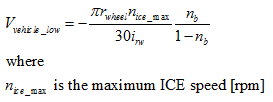
The speed Vvehicle_high is determined by the maximum ICE speed allowed nice_max. Beyond the nice_max operating efficiency of ICE may reduce. When the vehicle speed is higher than Vvehicle_high , the ICE speed is kept constant at nice_max and the EM starts working again with a negative speed to compensate for the ICE speed. The speed Vvehicle_high is given by
 |
(13) |
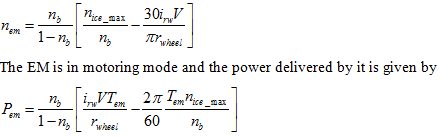
When the vehicle speed is higher than Vvehicle_high , for limiting the ICE speed below the maximum ICE speed (nice_max), the EM has to be operated in the direction opposite to the ICE speed, which as be expressed as
 |
(14)
(15) |
The first term in equation 15 is the total power delivered to the driven wheels and the second term is the power that the ICE produces. In this mode of operation the EM takes power from the batteries.
Traction Torque (TM) Control
The control of the TM is divided into three distinct regions, namely:
- Low vehicle speed region
- Medium vehicle speed region
- High vehicle speed region
The control action in each of the three regions is explained in the subsequent subsections.
Low vehicle speed region: When the vehicle speed is below Vvehicle_low the following actions are taken:
- The ICE is made to operate at nice_min. The ICE torque is marked 1 in Figure 9 and this torque is produced with an ICE throttle at which it has maximum fuel utilization efficiency at this speed.
- The point A in Figure 9 represents the traction torque command given by the driver and this required torque is greater than the torque that the ICE can produce with optimal ICE throttle as shown in Figure 9 . Hence, the ICE alone cannot handle this required torque and the additional torque has to be supplied by the TM.
- The magnitude of torque that the TM produces depends on the energy level of the batteries. When the SOC of the battery is lower than a specified minimum value of SOC
(SOCmin), the batteries do not supply energy to TM. In this case the maximum power to the TM is the power generated by the EM governed by equation 12 . - If the SOC of the battery is greater than SOCmin( SOC > SOCmin), the batteries support the TM and it is controlled to produce the required torque.
- When the required torque is smaller than the ICE torque produced with optimal throttle as shown by point B in Figure 9 and the SOC of the battery is less than SOCmin, then the ICE is operated at a speed of nice_min. The batteries are charged by the EM (the EM works in generator mode), hence, the torque produced by the ICE is used to drive the vehicle and charge the batteries.
- When the required torque is smaller than the ICE torque and the SOC of the battery lies between the SOCmin and SOCmax, the ICE and the EM are controlled in such a way so that the ICE operates with at a speed of nice_min and produce the required torque. The TM in this is de-energized.
- When the required torque is smaller than the ICE torque and the SOC of the battery is greater than SOCmax, then the ICE is turned off and the required torque is provided by the TM.