Drivetrain Control Techniques
The control system of the drivetrain is shown in Figure 1 . The vehicle controller unit (VCU) receives the traction or braking torque commands from the driver through the accelerator or brake pedals and other necessary operating information such as state of charge (SOC) of the PPS and the vehicle speed. Based on the real time information received and the control logic present in the VCU, the VCU generates control signals to control the ICE, EM, traction motor and the clutches and the locks. The control signals from the VCU are divided into following subsystems:
- ICE Speed Control
- Traction control
- Drive train control
ICE Speed Control:
The equation 4 shows that the ICE speed can be (nice) can be adjusted by controlling the EM speed (nem) at a given wheel speed (nwheel). The control procedure is as follows:
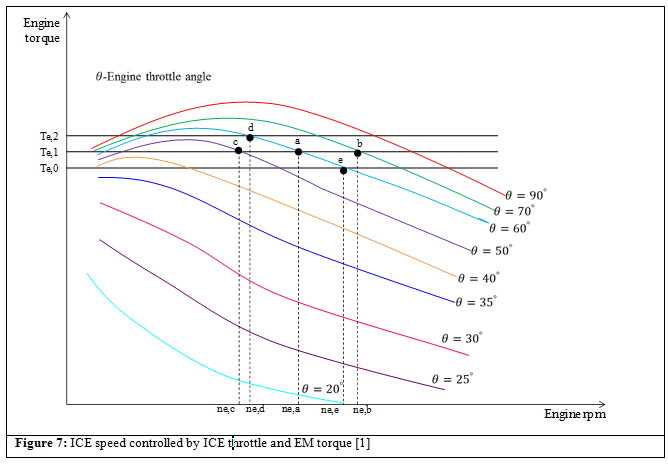
i. Suppose the ICE is operating at point a with a speed if nice, a producing a torque of Tice, 1 and the engine throttle angle (θ) is at 60o ( Figure 7 ).
ii. In order to balance the torque produced by the ICE, the EM has to produce torque Tem, 1= Tice / (1 - nb).
iii. As an example if the throttle opening angle is increased to θ = 70o and the torque produce by ICE and EM are kept fixed at Tice, 1 and Tem, 1 respectively, then the engine speed will increase and will settle at point b as shown in Figure 7 .
iv. If the ICE and EM torques are maintained at Tice, 1 and Tem, 1 respectively, reducing the throttle opening angle to 50 o will cause the engine speed to decrease to point c ( Figure 7 ).
v. If the throttle opening angle θ is kept constant, then from equation 5 it can be seen that the ICE speed can be controlled by changing the torque of EM
vi. For example if the throttle angle is kept fixed at 70o , then reducing the EM torque will result in increase of engine speed from point b to b' .
From the above discussion it can be seen that the ICE speed can be controlled within its optimal speed range by instantaneously controlling the engine throttle angle and/or the EM torque.