Introduction
The topics covered in this chapter are as follows:
- Drive Train Configuration
- Drivetrain Control Technique
- Traction Torque Control Approach
Drivetrain Configuration
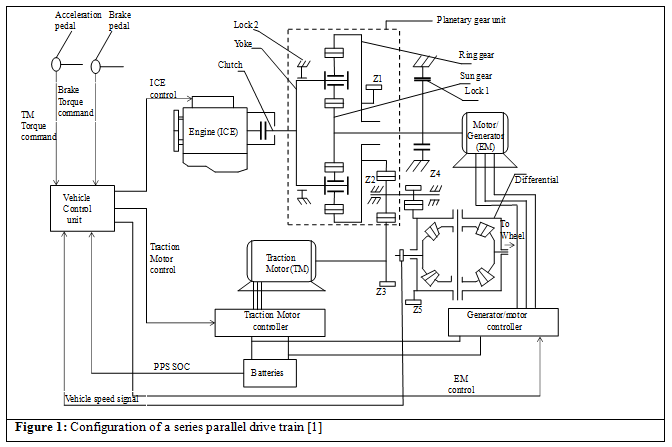
A typical series-parallel HEV drivetrain configuration is shown in shown in Figure 1 . The various connections in this drivetrain are as follows:
- The ICE and the EM are connected to the yoke and sun gear respectively.
- The ring gear of the planetary gear is connected to the drive wheels through gears
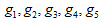 and a differential gear.
 - The traction motor is connected to the driven wheels through gears
 and the differential gear, which couples the output torques of the ring gear and the traction motor together.
 - One clutch and two brakes are used. The clutch connects or disconnects the engine to or from the yoke of the planetary gear.
- Lock 1 is used to lock or release the sun gear and the shaft of the IM to or from the stationary frame of the vehicle.
By controlling the clutch, locks, engine, IM and the traction motor, the following modes of operation are available:
Speed-Coupling Mode: In this mode the traction motor is does not provide any power to the drivetrain. The speed-coupling mode has three sub-modes:
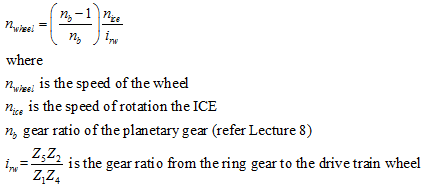
a. Engine only traction: The clutch is engaged to connect the engine to the yoke, lock 1 locks the sun gear to the vehicle stationary frame and the EM is de-energised. The energy flow path is shown in Figure 2 . In this case the entire traction power is delivered by the engine and the relation between the engine and the driven wheels is