Drive Train Control Strategies
The distinct features of the series parallel drive train are:
i. The ICE speed and torque can be decoupled completely or partially from the driven wheels through speed coupling or torque coupling
ii. It has much more flexibility than the series or parallel drivetrains in the choice of active operation mode thus providing more potential for the improvement of drive train efficiency and emissions
To enable the flexibility of operation suitable control strategies have to be developed and the objective of the control strategies should be:
i. high overall fuel utilization efficiency
ii. low emission.
The control strategy should meet both the condition under following constraints:
i. Always meeting the driver's torque command
ii. Always maintaining the state of the charge (SOC) of the energy storage system (batteries and/or supercapacitors) around 70% and never below 30%.
The control strategies used in the series-parallel drivetrain can be divided into two broad categories, namely:
i. ICE speed control strategies
ii. Traction torque control strategies
ICE Speed Control Strategy
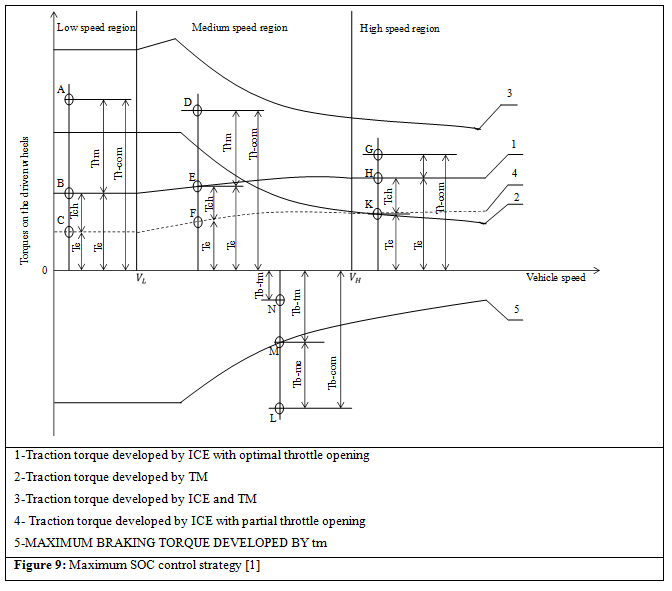
From Figure 8 and 9 it can be seen the vehicle speed is divided into three regions, namely:
- Low speed region
- Medium speed region
- High speed region
The vehicle speed  is determined by the lowest ICE speed allowed with zero EM speed and can be written as
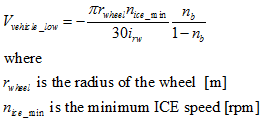 |
(7)
|
In the low vehicle speed region the EM has to be operated with a positive speed which is given by
(equation 4)
 |
(8)
(9)
(10) |