1.1 Designing K bY thansforming the state model into controllable from
The problem is first solved for the controllable canonical form. Let us denote the controllability matrix by UC and consider a transformation matrix T as

where 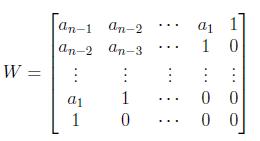
 's are the coefficients of the characteristic polynomial
 .
.
Define a new state vector  . This will transform the system given by (1) into controllable canonical form, as
 |
(3) |
You should verify that
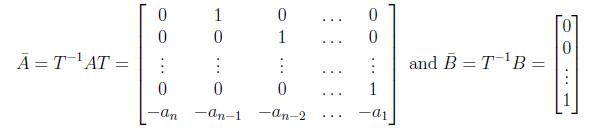
We first find  such that
 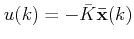 places poles in desired locations. Since eigenvalues remain unaffected under similarity transformation,
 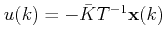 will also place the poles of the original system in desired locations.
If poles are placed at 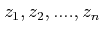 , the desired characteristic equation can be expressed as:
 |
(4) |
Since the pair  are in controllable-companion form then, we have
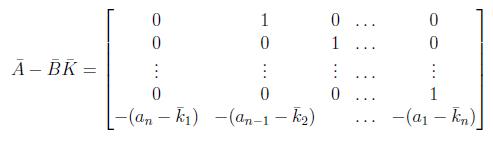
Please note that the characteristic equation of both original and canonical form is expressed as:  =
=  =
= 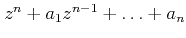 = 0.
= 0.
The characteristic equation of the closed loop system with  is given as:
 |
(5) |
Comparing Eqs. (4) and (5), we get
 |
(6) |
We need to compute the transformation matrix T to find the actual gain matrix
 where
where ![$ \bar{K}=[\bar{k}_1,\bar{k}_2,\ldots,\bar{k}_n]$](images/img42.png) .
.