2 Lyapunov Stability Theorems
In the last section we have discussed various stability definitions. But the big question is how do we determine or check the stability or instability of an equilibrium point?
Lyapunov introduced two methods.
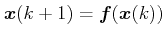
The first is called Lyapunov's first or indirect method : we have already seen it as the linearization technique. Start with a nonlinear system
 |
(10) |
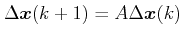
Expanding in Taylor series around  and neglecting higher order terms.
 |
(11) |
where
 |
(12) |
Then the nonlinear system (10) is asymptotically stable around xc if and only if the linear system (11) is; i.e., if all eigenvalues of A are inside the unit circle.
The above method is very popular because it is easy to apply and it works well for most systems, all we need to do is to be able to evaluate partial derivatives.
One disadvantage of the method is that if some eigenvalues of A are on the unit circle and the rest are inside the unit circle, then we cannot draw any conclusions, the equilibrium can be either stable or unstable.
The major drawback, however, is that since it involves linearization it is applied for situations when the initial conditions are ``close'' to the equilibrium. The method provides no indication as to how close is ``close'', which may be extremely important in practical applications.
The second method is Lyapunov's second or direct method: this is a generalization of Lagrange's concept of stability of minimum potential energy.
Consider the nonlinear system (10). Without loss of generality, we assume origin as the equilibrium point of the system.
Let us define the following
Lyapunov function candidate: A scalar function
 will be a Lyapunov function candidate if it has
the following properties:
will be a Lyapunov function candidate if it has
the following properties:
-

-
 , for
, for

Lyapunov function: Furthermore, if
is such that
 , then
it is called a Lyapunov function.
, then
it is called a Lyapunov function.
The origin of (10) will be asymptotically stable if there
exists a Lyapunov function along the trajectories of (10).
We can see that the method hinges on the existence of a Lyapunov function, which is an energy-like function, zero at equilibrium, positive definite everywhere else, and continuously decreasing as we approach the equilibrium.