Module 7 : Discrete State Space Models

Lecture 1 : Introduction to State Variable Model

2.1 State Equations of Sampled Data Systems

Let us assume that the following continuous time system is subject to sampling process with an interval of T.

We know that the solution to above state equation is:

$\displaystyle \boldsymbol{x}(t) = \Phi (t-t_0) \boldsymbol{x}(t_0)+\int_{t_0}^t \Phi (t-\tau) Bu(\tau)d\tau
$

Since the inputs are constants in between two sampling instants, one can write:
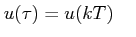
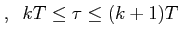
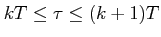
$\displaystyle u(\tau) = u(kT) \;\;\;\;$   for$\displaystyle , \;\; kT \le \tau \le (k+1)T $

which implies that the following expression is valid within the interval $ kT \le \tau \le (k+1)T$ if we consider $ t_0=kT$:
$\displaystyle \boldsymbol{x}(t) = \Phi (t-kT) \boldsymbol{x}(kT)+\int_{kT}^t \Phi (t-\tau) Bu(kT)d\tau
$

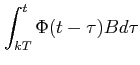
Let us denote $ \displaystyle \int_{kT}^t \Phi (t-\tau) B d\tau$ by $ \theta(t-KT)$. Then we can write:

$\displaystyle \boldsymbol{x}(t) = \Phi (t-kT) \boldsymbol{x}(kT)+\theta(t-KT)u(kT)
$

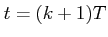
If $ t=(k+1)T$,

$\displaystyle \boldsymbol{x}((k+1)T) = \Phi (T) \boldsymbol{x}(kT)+\theta(T)u(kT)$ (4)