1.1 Correlation between state variable and transfer functions models
The transfer function corresponding to state variable model (1) , when u and y are scalars, is:
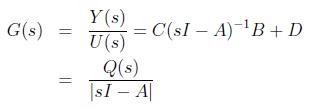 |
(2) |
where  is the characteristic polynomial of the system.
1.2 Solution of Continuous Time State Equation
The solution of state equation (1) is given as

where
 is known as the state transition matrix and
x(to)
is the initial state of the system.
is known as the state transition matrix and
x(to)
is the initial state of the system.
2 State Variable Analysis of Digital Control Systems
The discrete time systems, as discussed earlier, can be classified in two types.
1. Systems that result from sampling the continuous time system output at discrete instants only, i.e., sampled data systems.
2. Systems which are inherently discrete where the system states are defined only at discrete time instants and what happens in between is of no concern to us.