Module 5 : Design of Sampled Data Control Systems

Lecture 6 : Compensator Design Using Bode Plot

It can be shown that the frequency where the phase is maximum is given by

$\displaystyle \omega_{\max } = \frac{1}{{\tau \sqrt \alpha }}  $


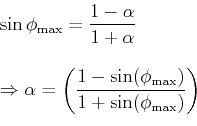
The maximum phase corresponds to

\begin{displaymath}  \begin{array}{l}  \sin \phi _{\max } = {\dfrac{{1 - \alpha...  ...} )}}{{1 + \sin (\phi _{\max } )}}} \right) \\  \end{array}  \end{displaymath}


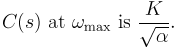
The magnitude of


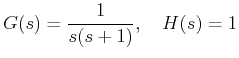
Example 1: Consider the following system
$\displaystyle G(s) = \frac{1}{{s(s + 1)}},\,\,\,\,\,\,H(s) = 1  $


Design a cascade lead compensator so that the phase margin (PM) is at least 45° and steady state error for a unit ramp input is 0.1 .

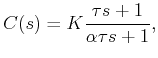
The lead compensator is

$\displaystyle C(s) = K \frac{\tau s+1}{\alpha \tau s+1},$ where, $\displaystyle \alpha < 1 $


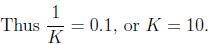
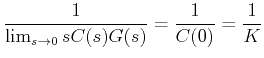
Steady state error for unit ramp input is
$\displaystyle \frac{1}{\lim_{s\to 0} s C(s) G(s)} = \frac{1}{C(0)} =  \frac{1}{K} $


PM of the closed loop system should be 45°. Let the gain crossover frequency of the uncompensated system with K be ωg .