As shown in Figure 4 (a), there is a s-a-0 fault in input b. To sensitize the fault, simply b is to be made 1. Now let us take the path “e-f-g-h” for propagating the effect to the output h. The signals in the nets of the path, in terms of Roth’s 5 valued algebra, are shown in Figure 4(a). It may be noted that we have successfully propagated  to the output; it implies that the fault can be propagated to the output using the path selected. Now let us justify the signals, by setting the inputs of the gates in the path selected (for fault propagation), but not themselves being in the path, to non-controlling values. For example, net j, is a input to the OR gate that is in the path selected for fault propagation, but j is not itself in the path; so j is to be 0. Similarly, d is to be 1, and a is to be 1. However, it must be noted that j cannot be made 0; if c=1 then j =D and if c = 0 then j = 1. So we have reached a conflict at j; Figure 4(b). Now we must backtrack and select a new path for propagation.

Figure 4. Illustration of backtrack in path sensitization based ATPG
Figure 5 shows the ATPG if the new path is “i-j-g-h”. Figure 5 (a) shows the values in the nets required to propagate the fault to the output. In the new path we have again successfully propagated the fault to the output, but now a D is obtained instead of (as in the previous case}. This implies that the fault can be propagated to the output using the new path, however, the reflection of the effect is reversed. To justify the signals, we require d=1, c=1, f=0. f=0 is easily obtained by setting a=0. So we have successfully, justified the signals if the path is “i-j-g-h”; test pattern is a=0,b=1,c=1, d=1 and effect at output is D.
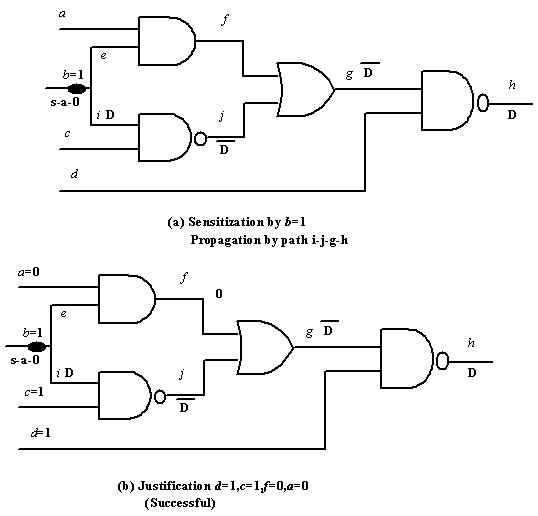
Figure 5. Successfully found test pattern in an alternative path (circuit of Figure 4)
5. Conclusions
In this lecture we have discussed the basic types of ATPG algorithms and a new 5 valued algebra required in all the major ATPG algorithms (based on path sensitization). In the next lecture we will study in detail the D-algorithm, which is the basis of all path sensitization based ATPG algorithms. As a point of motivation, it must be stated that most of the modern and widely accepted “deterministic” ATPG algorithms are based on path sensitization approach and roots drawn from D-algorithm.