4. Set operations on OBDDs
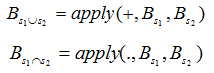
Since, we are able to represent sets and subsets with the help of OBDDs, we can also have union and intersection of OBDDs. All other operations that can be done on sets can also be done on OBDDs. The union and intersection operation can be done on OBDDs as follows.
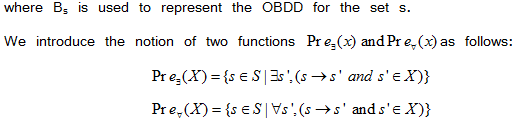
The function Pr e∃ takes a subset X of states S and returns the set of states which can make a transition into X . The function Pr e∀ takes a subset X of states S and returns the set of states which can make a transition only into X .

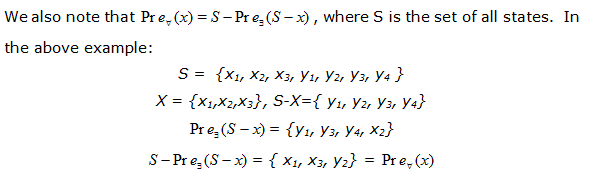
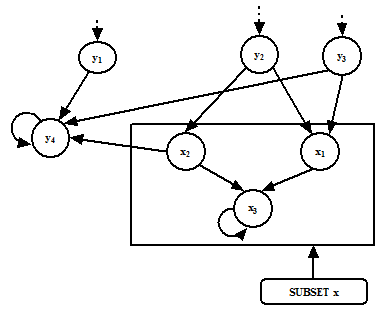
Figure 5. Example to illustrate the concept of 
5. Modelling of sequential circuits using ROBDD
There are two types of sequential circuits, synchronous and asynchronous.
5.1 Synchronous Sequential Circuits
For a synchronous finite state machine, the transition relation can be given as a conjunction of Boolean formulas, each determining the new state of one register as a function of its old state and the inputs. Let X={X1,X2,X3,X4,.....................,.Xn} be a set of Boolean variables representing the current state of the registers in the circuit. Note that there are n registers to hold each of the x i . Similarly let f = {f1,f2,f3,f4,.....................,.fn} define the value of register  in the next state denoted as X'= {
 } . Note that every f i is dependent on X and inputs. Now, the transition relation of the state machine can be expressed as a Boolean formula in the following form.
