1. Introduction
In the last two lectures we discussed that Reduced Ordered Binary Decision Diagrams (ROBDDs) are widely applied in verification because, they are canonical and for most of the Boolean functions they comprise much lower number of nodes compared to their DBT counterparts. Also we presented the construction of ROBDDs using Shannon's expansion. Another important property of ROBDDs is that all Boolean operations can be performed on them. For example, consider the AND gate shown in Figure 1 (a). The ROBDDs for the inputs “ a ” and “ b ” are shown in Figure 1 (b). The ROBDD for the output of the AND gate is shown in Figure 1 (c), which is computed using AND operation on the ROBDDs of the two inputs. It may be noted that ROBDD for the AND gate (or any other circuit) can be constructed by first determining the Boolean function at output and then constructing the ROBDD using Shannon's expansion. However, construction of ROBDD using Shannon's expansion (of the output function) is more cumbersome compared to procedure of using Boolean operations on input ROBDDs. The reason is, determining Boolean function of a large circuit and then apply Shannon's expansion iteratively is a complex task. In this lecture we will discuss operations on ROBDDs.
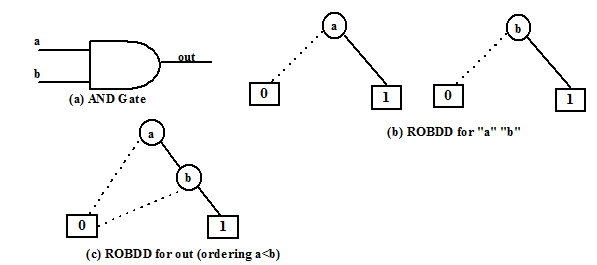
................................Figure 1. ROBDD AND gate with inputs “a ” and “ b ”
2. Operations of ROBDDs
Let there be two ROBDDs and representing Boolean expressions f and g , respectively. It is known that all Boolean operations can be done on f and g and the result is another Boolean expression. These operations can be performed on the ROBDDs and the resultant BDD ( may not be ordered and reduced, as explained shortly ) is the representation of the resultant Boolean expression.
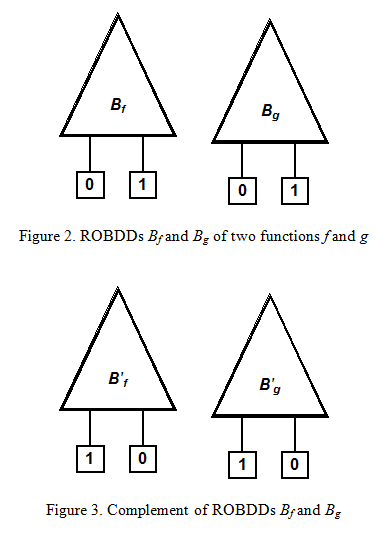
Figure 2 shows the ROBDDs Bf and Bg of two functions f and g (internal nodes are not shown). Figure 3 represents the BDDs for the complement of f and g ; it is very simple to get the BDD for the complement of a function, as we just need to reverse the values of leaf nodes. It may be noted that complement operation on ROBDD would result in a BDD that is ordered and reduced. However, this may not hold for other operations explained as follows.
..............................