Question and Answers
Question:
Formal definition of BDD does not restrict recurrence of a variable in the diagram any number of times. However, this can lead to redundant decisions taken at later stages. Illustrate this concept with an example.
Answer:
Example of a BDD with redundant decision is shown in Figure 18, where variable Y is tested twice along the same path X-Y-Z-Y .
Consider the following two paths in the BDD of Figure 18
Path-1 : x-y-z-y-1
Path-2: x-y-z-y-0
If we consider Path-2, then variable y is tested and taken the value to be 0 in first instance. Now along the path y is tested again and this time the value of y is considered to be 1. So, in this computation path, the truth value for y is considered to be 0 first and then as 1, which is not possible. This path is treated as inconsistent path.
In such type of situation, we need to consider only consistent path. A consistent path is one which, for every variable, has only dashed line or only solid line leaving nodes labeled by that variable. In other words, it is not possible to assign a variable the values 0 and 1 simultaneously.
But if we restrict the order of occurrence of variables from root to leaves, then along each path from top to bottom, each variable will occur only once and there would not be any redundant decision. Such diagram is called Ordered Binary Decision Diagram or OBDD.
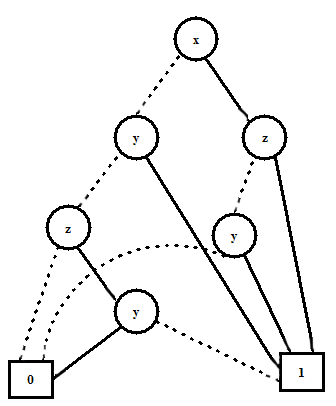
Figure 18. Example of a BDD with redundant decision