Consider another example for the Boolean function f(a,b,c) = ac+bc.
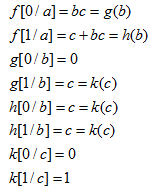
The diagram for the function built using Shannon's expansion is shown in Figure 16; the leaf level redundancies are eliminated using R1. In this case, it may be noted that there is another redundant node (encircled in Figure 16) and R2 can be applied. The final reduced BDD is shown in Figure 17.
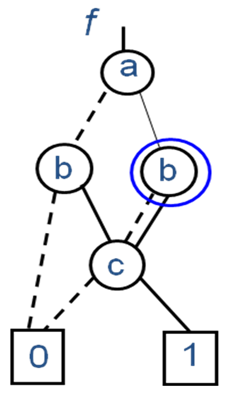
Figure 16. Diagram of the function f(a,b,c) = ac+bc. after applying R1
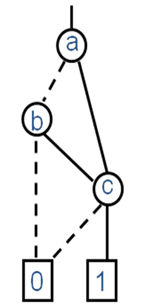
Figure 17. Final diagram (RBDD) of the function f(a,b,c) = ac + bc
5. Conclusions
In this lecture we discussed that equivalence checking of two Boolean expressions is best performed using BDT or truth tables. However, due to the exponential size of BDT or truth tables with respect to the number of inputs, use of BDTs or truth tables are not applicable to expressions even with reasonable complexity. To cater to this issue, RBDD which is BDT without any redundant nodes was proposed by R.E. Bryant. Using an example we illustrated the reduction in number of nodes in a RBBD compared to its BDT counter part. It may be noted that in all the examples there was an ordering of the variables namely, a<b<c . In other words in the RBDD, the root correspond variable “ a ”, the nodes of level 2 correspond variable “ b ” and the nodes of level 3 correspond variable “ c ”. Now a question arises, “what will happen if we change the ordering of variables?”, or “there is no ordering?”. The answer to first question is-- “the number of nodes in a RBDD depends heavily on ordering”. So to keep the size of RBDD minimal optimal ordering is to be determined; next lecture is related to Reduced Ordered Binary Decision Diagram (ROBDD). The answer to second question is—“if we do not restrict the order of occurrence of variables from root to leaves, then along each path from top to bottom there may be variables which occur more than once and there would be redundant decisions; the problem discussed in the question and answer section of this lecture illustrates this fact.