Module 2 : Global Positioning System
Lecture 6 : GPS Principles
Generation of GPS signals

The structure of GPS carrier signals and codes is quite complex in order to satisfy the several requirements as given below:

  • Multi-user system:
    • GPS is used for one-way measurements (a listen-only system)
  • Real-time positioning:
    • Since there is simultaneous measurements to many satellites, there is a need to identify different signals
    • Unambiguous range measurements - need to determine signal delay
    • Satellite positions needed hence one needs broadcast ephemerides
  • High accuracy positioning:
    • Microwave carrier frequency - 1.2 to 1.6 GHz; use of dual-frequency to minimize ionospheric delay
    • High frequency modulation
    • Anti-jamming requirement: GPS uses a special technique called the Spread spectrum technique for this purpose
  • Military and civilian users:
    • GPS needs two different codes and restriction on dual-frequency use in order to provide differential access to civilian and military/authorized users
  • Since the carriers are pure sinusoids, they cannot be used easily for instantaneous positioning purposes and therefore two binary codes are modulated onto them: the C/A (coarse acquisition) code and P (precise) code . The codes (P and C/A) are nothing but binary sequence of information which are generated by a complicated algorithm.
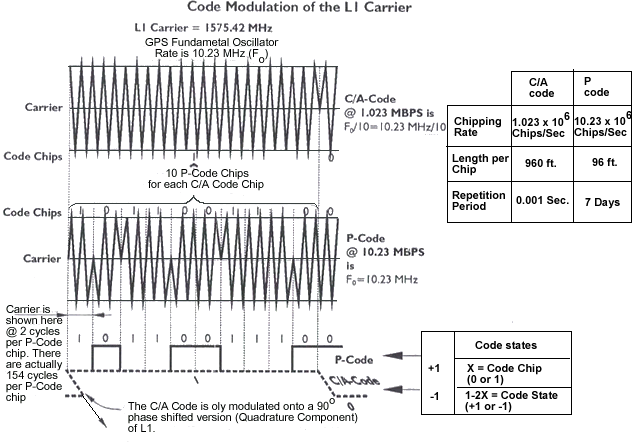
  • For purposes of imposing these binary data onto the carriers, all of the codes are transferred from the 0 and 1 states to the -1 and 1 status respectively. Figure 6.6 shows how both code and carrier are combined in L1 signal (Sickle, 2001). The technique is called binary biphase modulation (alternatively binary phase shift keying BPSK). For more details on signal structure one can refer to Seeber (2003), Sickle (2001) and Parkinson and Spilker (1996).

Figure 6.6 Code modulation of the L1 carrier (Sickle, 2001)

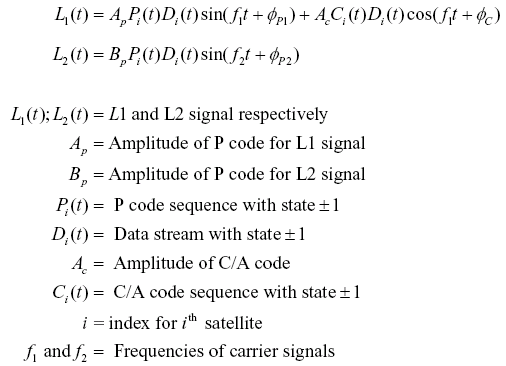
The structure of L1 and L2 signals is given below where epochs (times) of both codes and carriers are synchronized (Seeber, 2003):
 
  • Since the codes (PRN or pseudo random noise codes) and message are binary data streams, only two states of phase modulations are possible. The state +1 or -1 leaves the carrier unchanged; a code transition from +1 to -1 or from -1 to +1 involves a phase shift of 180 degrees.
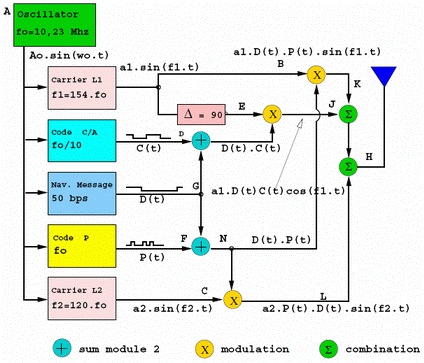
  • The L1 channel has to carry both P and C/A code. This arrangement is accomplished by a technique called phase quadrature . In this, the unmodulated L1 carrier is split off and shifted in phase by 90 degrees before it is mixed with the C/A code signal, and is then added to the modulated P code signal (Figure 6.7).
  • Satellite coordinates and additional information is sent within the broadcast data message which is also modulated onto the carriers. It is modulo-2 added to both the C/A code and the P code resulting in inversion of code and the autocorrelation function.

Figure 6.7 Generation of GPS signal (Pajares et al., 2004; Seeber, 2003)

GPS Services
Two types of services are available:
  • SPS (Standard Positioning Service)
    Positioning accuracy that is provided by GPS measurements based on the single L1 frequency C/A code .
  • PPS (Precise Positioning Service)
    Highest level of dynamic positioning accuracy that is provided by GPS measurements based on the dual frequency P-code .