The
two carrier waves L1 and L2 are pure right handed circularly
polarized sinusoidal waves. Two frequencies are useful to eliminate
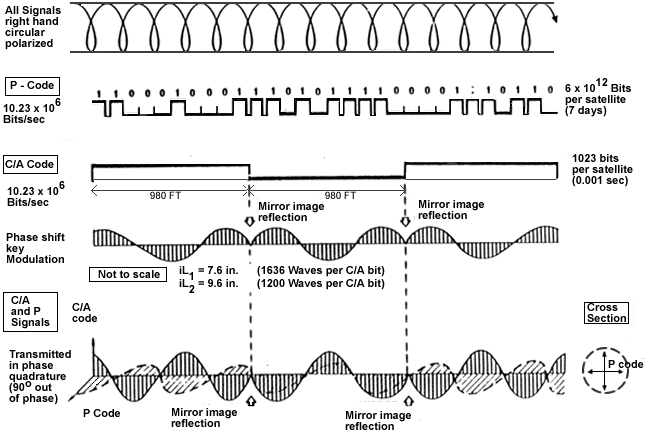
ionospheric effects (discussed later in Lecture 10). Figure 6.3
provides a schematic diagram for carriers
and codes for GPS signal.
GPS Codes
(a)
C/A Code
It is a binary sequence of information. It is also called
pseudo random noise (PRN) code (states of 0 and 1) consisting
of 1,023 elements, or chipsor bits, that repeats itself every
millisecond giving rise to a chipping rate (the rate at which
each chip is modulated onto the carrier) of 1.023 Mbps (mega
bits per second). The term pseudo random indicates that the
code is apparently random although it has been generated by
means of a known process, providing the repeatability.
PRN
codes allow range measurements, accesses to underlying carrier signals, satellite
message, and time markers.
The chip length (distance corresponding to
one chip or bit) corresponds to 293 m in length.
Due to the code length,
the ambiguity in measurement with C/A code is approximately 293 km - i.e the
complete C/A code pattern repeats itself every 293 km between the receiver and
the satellite.
(b) P code
Very long sequence (about 1014) of pseudo random
binary biphase modulations on the GPS carrier at a chip rate
of 10.23 MHz which repeats itself every 266 days. Each one-week
segment of the P-code is unique to one GPS satellite and
is reset each week.
The chip length (distance corresponding to one chip or bit) corresponds to 29.3 m in length.
C/A and P codes are rotated by 900 (called phase quadrature)
to each other.
Figure 6.3 Structure of various types of GPS signals (Kulshreshta,
1997)