Module 2 : Global Positioning System
Lecture 6 : GPS Principles
Satellite or navigational message
  • Navigational message includes information on
    • Satellite time of transmission
    • Precise satellite position (ephemeris)
    • Satellite health
    • Satellite clock correction
    • Propagation delay effects (due to signal propagation in ionosphere and troposphere)
    • Time transfer to UTC (Coordinated Universal Time)
    • GPS satellite Constellation status
  • Length of navigation message is 1500 bits which is modulated onto both L1 and L2 carriers. Message takes about 30 seconds, each second contains 50 bits.
  • Data is modulated at a much slower rate of 50 bps and thus it takes 12.5 minutes to transmit all of the information. In order to reduce the time it takes to obtain an initial position, the ephemeris and clock data is repeated every 30 seconds.
  • Each satellite sends (Parkinson and Spilker, 1996):
    • a full and precise description of its own orbit and clock data (within the ephemeris information) and an approximate guide to the orbits of other satellites (almanac information).
    • parameters representing the delay caused by signal propagation through the ionosphere (called the ionospheric propagation delay parameters).
  • Accuracy of some aspects included in navigation message deteriorate with time which are updated by certain renewal mechanisms from the ground monitoring stations.
Contents of subframes
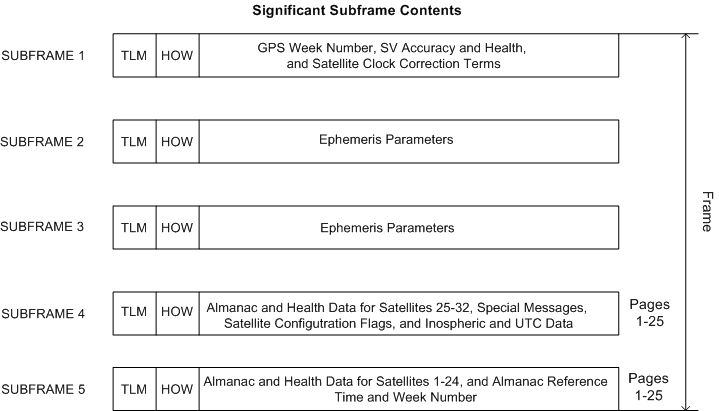
Navigational message contains 5 subframes, each of 10 words with each word of 30 bits (Figure 6.4).

Figure 6.4 Frame and subframes in Navigational message (Pajares et al., 2004)

Each subframe contains a telemetry (TLM) and handover (HOW) word which is spaced 6 seconds uniformly and contains system time. HOW is part of GPS message containing time synchronization information for transfer from C/A code to P code. The following description briefly provides contents of different subframes (Figure 6.5):
  • Subframe 1

    • Clock correction parameters, giving the satellite clock offset from GPS time.
    • Coefficient of the ionospheric propagation delay model for single frequency users (only L1 detection).
  • Subframe 2 and 3
    • Satellite ephemeris from which satellite coordinates in instantaneous coordinate system can be determined.
  • Subframe 4
    • Reserved for alphanumeric message for future applications and almanac data for satellites 25 through 32
  • Subframe 5
    • Almanac data for one satellite, successive subframes (5) will contain almanac data for up to 24 satellites.

First 3 subframes are refreshed every hour with ephemeris data that are applicable to new time period (and are valid for 1.5 hours). Subframes 4 and 5 are refreshed at the upload time (nominally each day).


Figure 6.5 Navigational message content and format overview