During
GPS based positioning, the following steps are followed (Enge
and Misra, 1999):
- Basic navigation point position can be calculated like a resection in which satellites are the orbiting control stations .
- Range vectors are measured to each of the satellites using
a time dependent code based on the times of transmission
and receipt of the signals.
- Since these times are biased by a common amount due to
offset between the satellite and receiver clocks ; they are
called pseudoranges .
- Pseudorange measurements from four satellites are needed
to estimate the user position and the corresponding receiver
clock bias.
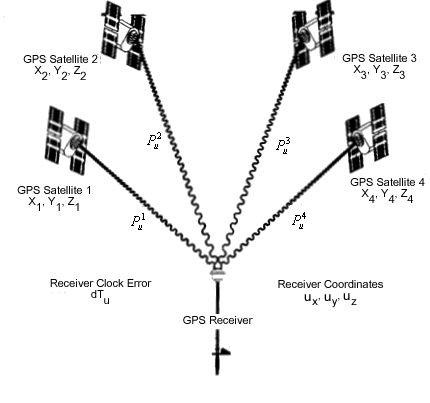
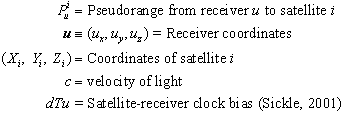
The above principle is explained in Figure 6.1 where 4
known GPS satellite coordinates are shown as (Xi,
Yi, Zi).
The unknown coordinates of GPS receiver u=(Ux,
Uy, Uz) are calculated by solving 4 range (or pseudorange
P) equations. A minimum of four equations are needed to solve
for four unknowns- three unknown position coordinates (Ux,
Uy, Uz) and to
account for the fact that atomic clocks onboard GPS satellites
and quartz clocks in GPS receivers are not synchronized. This
unknown time variable is called receiver time offset or bias
(dTu). |